
Homeowner Tips & Guides
From fingernail-catching scratches to cracks wider than 1/16 inch, these five warning signs mean DIY care is no longer enough. Discover when professional terrazzo floor restoration in Miami is the right call.
Terrazzo floors need professional repair when you notice deep scratches that catch a fingernail, pitting or spalling across more than 10% of the surface, persistent staining that survives three cleaning attempts, visible cracks wider than 1/16 inch, or a dull haze that no amount of buffing removes. These five conditions signal that DIY care is no longer enough and that terrazzo floor restoration in Miami by a licensed professional is the right next step.
Miami's mid-century homes are full of terrazzo floors, and for good reason. The material is durable, cool underfoot, and visually striking. But terrazzo is not invincible. South Florida's humidity, salt air, and heavy foot traffic take a real toll over decades. Knowing when to call a professional, and when to handle routine care yourself, saves you money and protects a surface that genuinely adds value to your home.
Most Miami terrazzo dates from the 1940s through the 1970s, when the material was poured in place over a concrete subfloor, embedded with marble, glass, or granite chips, then ground and polished smooth. This process created a seamless surface without grout lines, which is one reason terrazzo outperformed ceramic tile in Florida's humid climate. The binder is typically Portland cement, though some later installations used epoxy. Cement-based terrazzo is porous and reactive to acid, while epoxy terrazzo is denser and more stain-resistant. Knowing which type you have determines how you clean it and what restoration method works best.
Surface scratches from furniture or pet claws are normal wear. The test is simple: run your fingernail across the mark. If your nail catches and drops into a groove, the scratch has cut through the sealer and into the terrazzo matrix itself. At that depth, polishing compound alone will not level the surface. A professional uses a series of diamond-abrasive grinding pads, typically starting at 50 grit and working up to 800 or 1,500 grit, to re-level the floor before polishing and resealing. Attempting this with a consumer floor buffer risks uneven removal and permanent dull patches.
Pitting looks like tiny craters or rough patches scattered across the floor. It happens when the cement binder deteriorates, often from years of cleaning with acidic products like vinegar, citrus-based sprays, or unrinsed floor cleaners. Once 10% or more of your floor shows pitting, spot repairs become impractical because color and texture matching across a large area is difficult without a full grind. A professional restoration contractor will assess whether a full regrind or a micro-topping repair is the right approach. Either way, this is not a DIY job.
Terrazzo is porous when unsealed or when the sealer has worn away. Coffee, red wine, rust from furniture legs, and mold from Miami's humidity can all penetrate the binder and bond at a molecular level. If a pH-neutral cleaner, followed by a poultice treatment, followed by a professional-grade alkaline degreaser all fail to lift a stain, the pigment has migrated below the surface. Restoration requires grinding down past the stained layer, which removes between 1/32 and 1/8 of an inch of material depending on depth, then re-polishing and resealing the entire section.
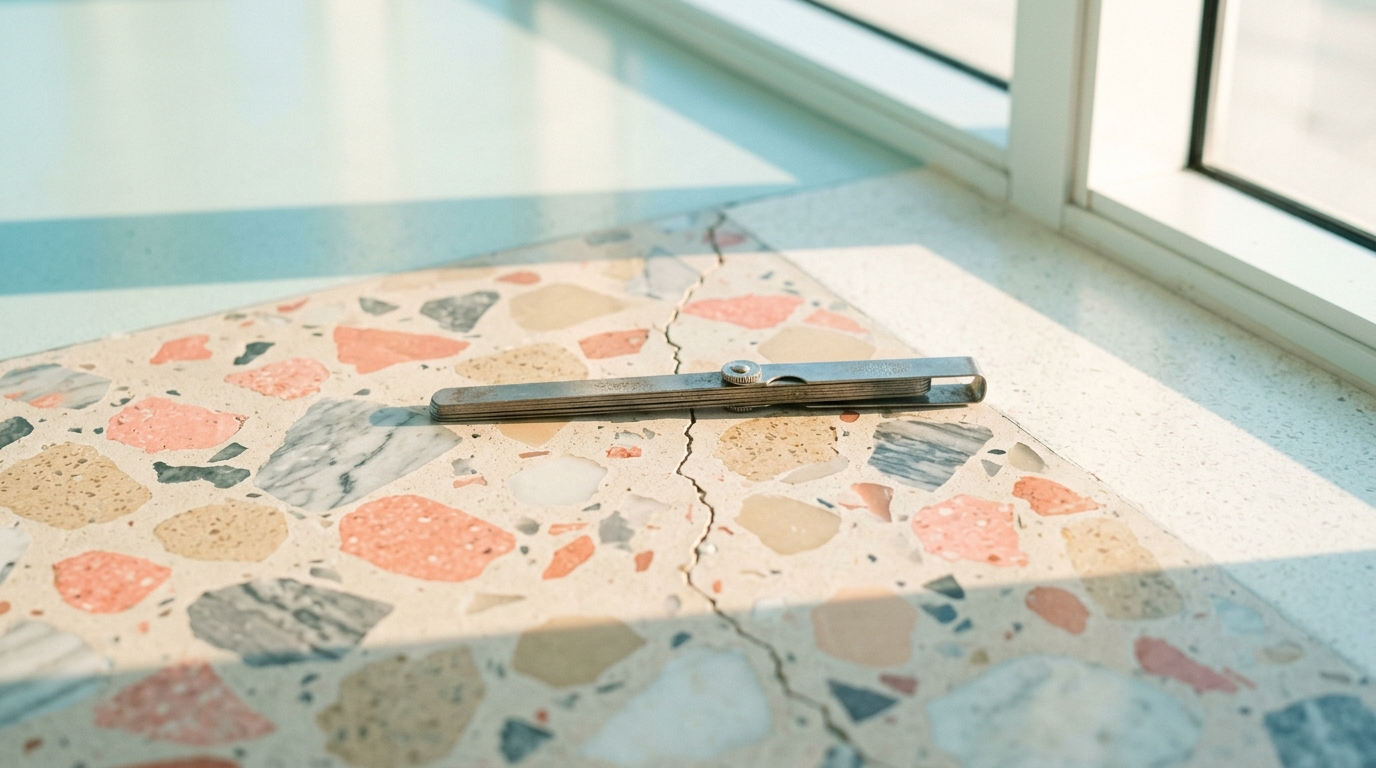
Hairline cracks in terrazzo are common and often stable. A crack wider than 1/16 inch (about 1.6 mm) is a structural signal. In Miami, cracks this size frequently trace back to subfloor movement, which can result from soil shifting, plumbing leaks beneath the slab, or thermal expansion in older concrete. Filling a wide crack with epoxy without addressing the subfloor cause means the crack reopens, sometimes within months. A qualified handyman or flooring contractor will probe the subfloor, confirm the cause, and use a flexible epoxy or polyurethane injection system that accommodates minor movement rather than a rigid filler that fails under stress.
A properly polished and sealed terrazzo floor has a wet-stone reflective sheen. If your floor looks consistently cloudy or chalky despite regular cleaning and buffing, the sealer has either carbonated (reacted with alkaline cleaning products to form a white film) or it has simply worn away and the terrazzo surface has micro-oxidized. Both conditions require chemical stripping of the old sealer, a fresh diamond polish sequence, and application of a penetrating sealer rather than a topical wax. Wax builds up over time and is the most common reason Miami terrazzo floors develop that dull, yellowed appearance in older homes.
Proper maintenance extends the time between professional restorations significantly. Follow these steps consistently:
The cost to restore terrazzo floors in Miami ranges from $3 to $8 per square foot for standard grinding, polishing, and sealing. Repairs involving crack injection, deep stain removal, or color infill to replace missing aggregate run $8 to $15 per square foot. A full restoration of a 1,000-square-foot Miami bungalow floor typically costs between $3,000 and $8,000 depending on the floor's condition, the number of repair areas, and whether the contractor uses wet or dry grinding methods.
The following comparison helps homeowners decide between partial and full restoration:
| Repair Type | Typical Cost (Miami, 2026) | Best When |
|---|---|---|
| Spot crack repair only | $150–$400 per crack | Crack is isolated, subfloor is stable |
| Partial regrind and polish (single room) | $600–$1,500 | Damage limited to one area, rest of floor is sound |
| Full home restoration (grind, polish, seal) | $3,000–$8,000 | Widespread dullness, staining, or pitting throughout home |
| Deep stain removal with color infill | $8–$15 per sq ft | Stains that survived multiple cleaning attempts |
A reputable terrazzo restoration contractor in Miami will offer a written estimate after an in-person assessment. Be cautious of quotes given over the phone without a site visit, as terrazzo condition varies significantly from room to room in the same home.
A skilled handyman can handle sealer application, minor grout-line repairs in older terrazzo borders, and furniture felt pad installation to prevent future scratching. For grinding, polishing, and crack injection, you need a contractor who owns industrial diamond-disc grinders and has experience matching Miami's specific mid-century terrazzo aggregate blends. Mismatched aggregate or incorrect grit sequences leave permanent color inconsistencies that are expensive to fix.
If you are managing an apartment building or working through a home renovation, coordinating terrazzo restoration alongside electrical updates, AC service, or plumbing work through a single reliable service provider saves scheduling time and reduces the number of contractors accessing the property.
A standard full-home restoration of 1,000 square feet takes 2 to 4 days: one day for grinding, one day for polishing, and one day for sealer application and cure time. Crack repairs and stain removal add 1 to 2 days depending on the number of problem areas. The floor is walkable 24 hours after sealing but should not receive heavy furniture for 72 hours.
You can handle cleaning, sealer application, and minor buffing yourself. Grinding and re-polishing require industrial diamond-disc machines that most rental centers do not stock in the grits needed for terrazzo. Attempting to grind terrazzo with a standard floor buffer removes the cream layer unevenly and creates permanent low spots that require a professional to correct, at greater expense than the original restoration would have cost.
A penetrating lithium silicate or siliconate sealer is the correct choice for cement-based terrazzo in Miami. These sealers bond chemically with the concrete binder rather than sitting on top, which means they do not yellow, peel, or build up with repeated applications. Avoid topical acrylic waxes: they trap moisture beneath the surface in humid climates and cause the milky haze that many Miami homeowners mistake for damaged terrazzo.
Pour a small amount of water on an inconspicuous area. Cement terrazzo absorbs water within 30–60 seconds. Epoxy terrazzo beads water indefinitely. You can also look at the installation date: floors poured before 1980 in Miami are almost always cement-based. Epoxy terrazzo became more common in commercial and residential new construction after 1990. The distinction matters because epoxy terrazzo uses different grinding compounds and does not require the same sealer chemistry.
Restored terrazzo floors are a documented selling point in Miami's mid-century real estate market. Real estate professionals in Miami-Dade County note that buyers actively search for intact original terrazzo and will pay a premium over comparable homes with carpet or laminate over the original slab. Restoration costs of $3,000 to $8,000 consistently return more than their cost at resale in the Miami market, making professional terrazzo floor restoration one of the higher-ROI home improvements available to South Florida homeowners.
Call us today or fill out the form and we'll call you back within 2 business hours. Plans start at $69.99/mo.
1-833-426-3942