
Homeowner Tips & Guides
Miami's heat and humidity push AC systems to their limits year-round. Learn the 5 mechanical warning signs that signal imminent failure and when to call an ac repair miami technician before costs spiral.
If your AC unit is showing any of the five warning signs below, failure is likely within days to weeks, not months. Miami's climate runs compressors harder than almost any other metro in the continental United States, and catching a breakdown early cuts repair costs significantly compared to an emergency call after total system failure.
Miami sits at roughly 80% average relative humidity year-round. That combination of heat and moisture forces residential and commercial AC systems to run near capacity for 10 or more months of the year. A system that might last 15 years in a dry climate often shows serious wear in 10–12 years here. Coastal salt air accelerates corrosion on condenser coils and electrical contacts. The result: components that wear out on a compressed timeline, and warning signs that appear quickly once degradation starts.
Understanding what those signs look like mechanically, not just symptomatically, lets homeowners and apartment managers intervene before a $400 repair becomes a $3,000 compressor replacement.
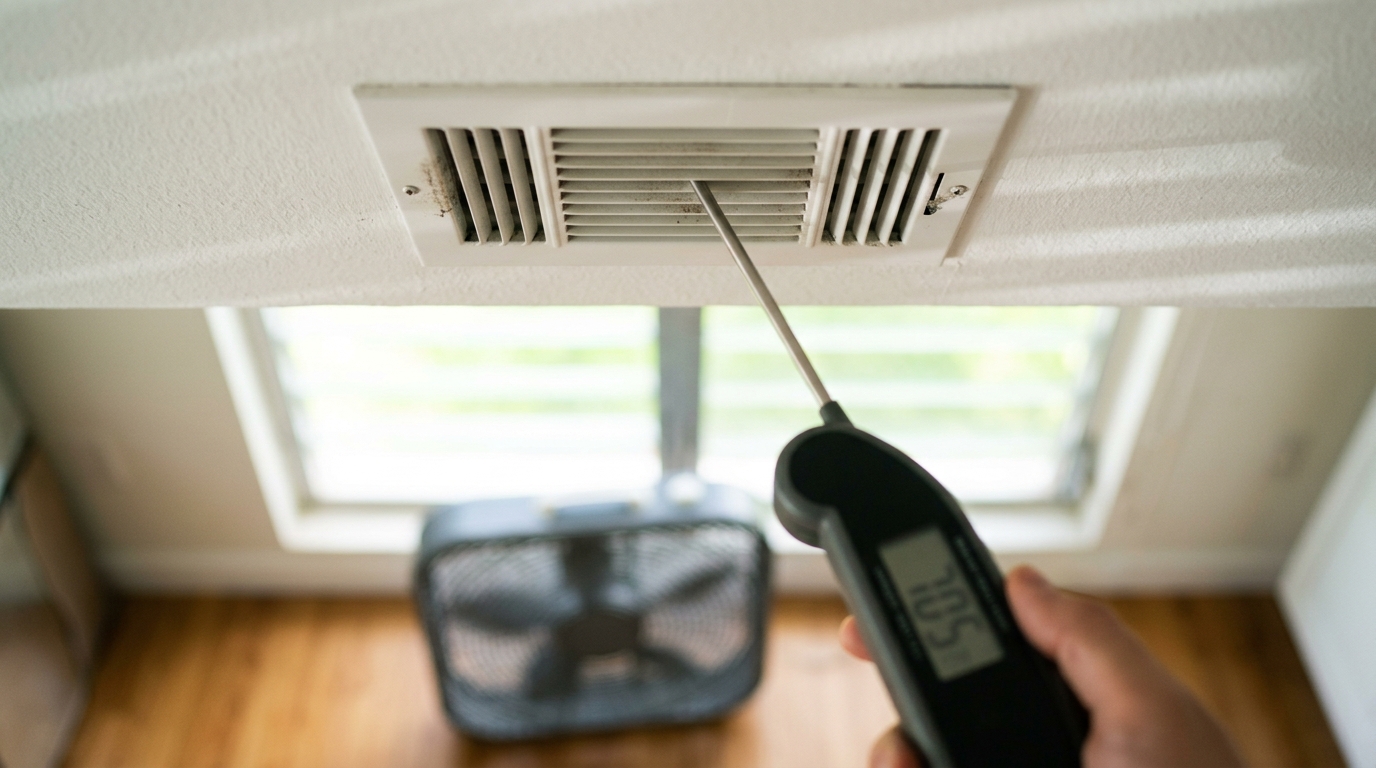
A functioning split system should drop supply air temperature by 15–20°F below the return air temperature. If the supply vents are blowing air that feels only slightly cooler, or at room temperature, the system is failing to absorb heat from the indoor air. The three most common causes are low refrigerant charge, a failing compressor, and a blocked or iced evaporator coil.
Low refrigerant in Miami almost always means a leak, not just a top-off situation. Adding refrigerant without finding the leak is a temporary patch. A licensed technician locates leaks using electronic detection or UV dye, repairs the breach, then recharges to manufacturer spec (typically 410A at 250–350 PSI on the high side, depending on the unit). A compressor drawing amperage in the correct range but not producing adequate pressure difference is a strong indicator the compressor's valves are worn, a repair that usually means full compressor replacement.
Ice on an AC system is counterintuitive but serious. It forms when airflow across the evaporator coil drops below roughly 350 CFM per ton of capacity, or when refrigerant charge is insufficient to maintain proper coil temperature. In Miami's humidity, ice accumulation is rapid because moisture in the air freezes on already-cold coil surfaces, restricting airflow further and accelerating the problem.
The practical fix begins with turning the system to fan-only mode for 2–4 hours to thaw the coil without water damage. After thawing, check or replace the air filter (a clogged filter is the leading cause of restricted airflow), inspect the evaporator coil for dirt buildup, and verify that all supply and return vents are open and unobstructed. If ice returns within 24 hours of a clean filter and clear coils, a refrigerant leak or failing blower motor is the next diagnostic step. Do not ignore recurring ice. It stresses the compressor by causing liquid refrigerant to return to it, which destroys the compressor's internal valves over weeks.
AC systems produce some operational noise, typically a steady hum and airflow sound. Deviation from that baseline is a diagnostic signal, and the type of noise maps closely to a specific component:
When you hear any of these sounds, scheduling same day repair is the right call. Miami summers do not allow for "let's see if it gets worse" logic. Heat stress on an already-strained system compounds failure exponentially.
An air conditioner is also a dehumidifier. As warm indoor air passes over the evaporator coil, moisture condenses on the coil and drains out through the condensate line. In Miami, this function is as important as cooling. When indoor humidity stays above 60% consistently, it signals one of three failure modes:
A blocked condensate drain is the easiest fix: flush with a mixture of water and white vinegar, or use a wet-vac on the exterior drain port. A clogged line left unaddressed causes pan overflow, water damage to ceilings and walls, and mold growth, which is a significant liability for apartment managers. System oversizing requires a Manual J load calculation to confirm, and the solution is typically a variable-speed unit that can run at lower capacity for longer cycles to wring humidity from the air.
A sudden increase in electricity consumption without a corresponding change in thermostat settings or occupancy is one of the clearest indicators of mechanical inefficiency. In Miami, where AC can account for 50–60% of a home's total electric bill, a 20% spike on the AC circuit translates to a meaningful dollar amount month over month.
The most common causes are dirty condenser coils (forcing the compressor to work harder to reject heat), a failing capacitor (causing the compressor and fan motors to draw extra amperage at startup), or refrigerant loss reducing system efficiency. Condenser coil cleaning is part of a standard HVAC maintenance checklist and takes approximately 30–45 minutes with a coil cleaner and garden hose. A failing capacitor is a $30–$80 part and a straightforward replacement for a technician. Neither repair is expensive, but both are time-sensitive because running a system in degraded condition accelerates compressor wear at a rate that outpaces the cost of timely air conditioning service.
| Task | Frequency | Who Performs It | What It Prevents |
|---|---|---|---|
| Replace air filter (MERV 8–11) | Every 30–60 days | Homeowner / tenant | Coil icing, blower motor strain |
| Flush condensate drain line | Every 90 days | Homeowner / handyman | Water overflow, mold growth |
| Clean outdoor condenser coils | Twice per year | Technician or handyman | Efficiency loss, compressor overload |
| Inspect electrical connections and capacitors | Annually | Licensed HVAC technician | Short-cycling, motor failure |
| Check refrigerant pressure | Annually | Licensed HVAC technician | Coil icing, warm air, compressor damage |
| Test thermostat calibration | Annually | Homeowner / technician | Short-cycling, overcooling |
In Miami, any AC failure between May and October is an urgent health matter, not a convenience issue. Indoor temperatures in a sealed home can reach 95°F or higher within hours on a summer afternoon. Elderly residents, young children, and pets face heat-related illness risk within that window. A same day repair call is appropriate any time cooling is completely lost, ice has formed on the system, or unusual sounds indicate imminent component failure. Reputable AC repair services in Miami carry common parts like capacitors, contactors, and drain pan treatments on their vehicles, making same day resolution realistic for most non-compressor failures.
For apartment managers overseeing multiple units, establishing a service relationship with an AC repair company that offers a one year warranty on parts and labor provides meaningful protection against callback costs and tenant complaints.
A properly maintained residential split system lasts 10–14 years in Miami, compared to 15–18 years in cooler, drier climates. Salt air corrosion and continuous runtime shorten the effective service life. Annual professional maintenance extends the lifespan by 2–4 years on average.
Most residential systems installed after 2015 use R-410A refrigerant. Systems installed before 2010 may still use R-22 (Freon), which has been phased out of production and is now significantly more expensive to source. If your R-22 system has a refrigerant leak, replacement is typically more cost-effective than recharging with limited-supply refrigerant.
Common repairs range from $150–$350 for capacitor or contactor replacement, $300–$600 for refrigerant leak repair and recharge, and $1,200–$2,500 for evaporator or condenser coil replacement. Full compressor replacement runs $1,500–$3,500 depending on tonnage. Emergency or same day service typically adds a $75–$150 dispatch fee.
Yes. A clogged filter is the single most common root cause of evaporator coil icing and blower motor burnout. When airflow is restricted below design CFM, the evaporator coil temperature drops below freezing, ice forms, and refrigerant returns to the compressor in liquid form. Liquid slugging destroys compressor valves. A $5 filter replacement prevents a $2,000+ compressor repair.
Prioritize companies that are Florida-licensed (HVAC Contractor license, Class A or B), carry liability insurance, and offer a written one year warranty on both parts and labor. Same day availability is critical during peak summer months. Ask whether the technician will provide a written diagnosis before starting work so you can evaluate repair versus replacement before committing.
Call us today or fill out the form and we'll call you back within 2 business hours. Plans start at $69.99/mo.
1-833-426-3942