
Homeowner Tips & Guides
When your AC stops cooling in Miami, seven quick checks can resolve about one in three no-cool calls. Work through the thermostat, breaker, filter, coil, drain line, and outdoor unit before calling a pro.
When your AC stops working in a Miami home, take seven steps in order: check the thermostat, inspect the breaker, replace the air filter, look for ice on the evaporator coil, clear the condensate drain line, clean the outdoor unit, and then call a licensed technician. These steps resolve roughly one in three no-cool calls without a service visit, and they give your repair technician useful information when you do need one.
Set the thermostat to "Cool" and the fan to "Auto," then lower the target temperature 5°F below the current room temperature. If the screen is blank, replace the batteries. Smart thermostats also lose Wi-Fi schedules after outages and may revert to "Away" or "Eco" mode. If the system does not start within 5 minutes, which is the typical compressor delay, move to Step 2.
Central AC uses two electrical points: a double-pole breaker in your panel (usually 30–60 amps) and a disconnect box mounted near the outdoor condenser. Flip the breaker fully off, wait 30 seconds, and switch it back on once. Do not reset it repeatedly. A breaker that trips again within minutes signals a shorted compressor, a failed capacitor, or damaged wiring, and repeated resets can start a fire. At that point you need emergency electrical repair, not more DIY attempts.
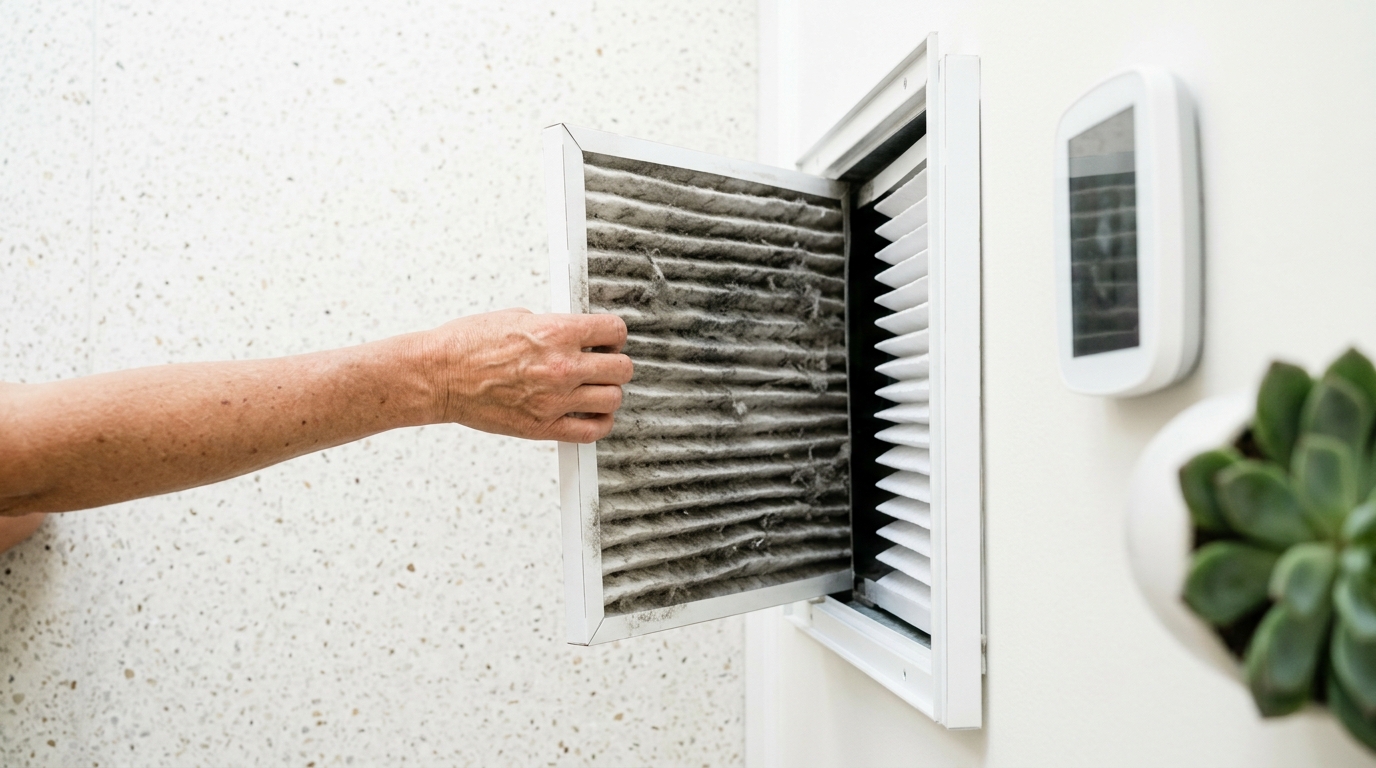
A clogged filter restricts airflow and is the most common cause of a freezing coil. In Miami's year-round cooling season, replace 1-inch filters every 30–60 days. Homes with pets or construction dust need changes every 30 days. Slide the old filter out and confirm the arrow on the new one points toward the air handler.
Ice on the copper suction line or the indoor coil means airflow or refrigerant is off. Turn the AC off at the thermostat, set the fan to "On," and let the ice melt for 2–4 hours. Never chip it off. Running the compressor while frozen can cause liquid slugging and compressor failure, a repair that often costs more than half the price of a new system. If ice returns within a day after a new filter, the cause is likely a refrigerant leak or a failing blower, both of which need a technician.
Miami's humidity means your AC removes several gallons of water daily. When algae clogs the PVC drain line, a float switch shuts the system down to prevent water damage. Find the drain's access tee near the indoor unit, and pour in 1 cup of distilled white vinegar. A wet/dry vacuum on the outside drain termination can also pull out the clog. Standing water in the secondary pan means the primary line is blocked. This is also where a leaking pipe repair call may overlap with HVAC, so confirm whether the water is condensate or a supply line.
Turn off power at the disconnect, then clear leaves, palm fronds, and debris within 2 feet of the unit. Rinse the fins gently from the inside out with a garden hose, never a pressure washer. Blocked fins cause the unit to overheat and shut off on high-pressure limits, which is common after storms.
Note what you see and hear before calling. Useful details include a humming without fan spin (often a bad capacitor), a clicking sound at startup, warm air from vents, or a burning smell. Ask any provider about licensing, a One Year Warranty on repairs, and Same Day Repair availability. Searching "AC repair near me" gives you options, but verify a current Florida license number before anyone opens your equipment.
| Symptom | Likely Cause | Action |
|---|---|---|
| Blank thermostat | Dead batteries or tripped float switch | DIY: replace batteries, check drain |
| Warm air, outdoor fan not spinning | Failed capacitor or contactor | Call a technician same day |
| Ice on lines | Dirty filter or low refrigerant | Thaw, replace filter, call if it recurs |
| Breaker trips repeatedly | Short or failing compressor | Stop and call an electrician |
| Water around air handler | Clogged condensate line | DIY flush, or call if it persists |
| Burning smell | Overheated wiring or motor | Shut off power, call immediately |
If you find a leaking pipe, locate the main shutoff valve, usually near the water meter or where the line enters the house, and turn it clockwise. Open the lowest faucet to drain pressure. Move electronics and furniture away from the wet area, and photograph the damage for insurance. Small pinhole leaks in copper can be held temporarily with a rubber-and-clamp repair kit, but this is only a bridge to a professional fix. Miami's older homes often have galvanized or aging copper lines, and one failure usually signals more.
Water near outlets, light fixtures, or the electrical panel is an electrical hazard. Shut off power to that area at the breaker only if you can reach it without standing in water. Otherwise call for help first.
If your power is out but neighbors have power, or you see scorched outlets, buzzing panels, or flickering after restoration, schedule emergency electrical repair with a Miami electrician right away.
A handyman handles filter changes, thermostat swaps, drain line flushes, and minor fixture repairs. Refrigerant work requires EPA Section 608 certification, and panel, wiring, or compressor work requires licensed electrical or mechanical contractors in Florida. For property managers, a single provider that coordinates handyman services, electrical, and AC under one call reduces downtime between tenant complaints and repairs. Same-day handyman availability matters most during Miami's hottest months, when indoor temperatures can pass 85°F within hours.
Most households can manage a day or two with fans and shade, but infants, seniors, and people with medical conditions face risk once indoor temperatures pass 85°F. Seek a cooler location and call for same-day service.
Common causes are a dirty condenser, low refrigerant, a failed capacitor, or a frozen coil. Check the filter and outdoor unit first. Anything beyond that requires a technician.
No. Reset it once. If it trips again, a short or overloaded component is present, and further resets risk fire and equipment damage.
Turn the system off, check the condensate drain line and pan, and flush the line with vinegar. If water continues, call a technician to repair the drain, pump, or coil.
Call an electrician if breakers trip, outlets are warm, or you smell burning. Call an AC technician if the system has power but does not cool.
Call us today or fill out the form and we'll call you back within 2 business hours. Plans start at $69.99/mo.
1-833-426-3942