
Homeowner Tips & Guides
Commercial pressure washing in Miami demands precise PSI settings, Miami-Dade compliance, and a schedule built around South Florida's wet and dry seasons. Get every detail right in this 2026 guide.
Commercial pressure washing in Miami requires PSI settings between 1,500 and 4,000 depending on surface type, compliance with Miami-Dade County water discharge regulations, and a maintenance schedule timed around South Florida's wet and dry seasons. Skipping any of these factors leads to surface damage, code violations, or cleaning results that last less than 60 days before mold and algae return.
Miami's climate is one of the most demanding in North America for building exteriors. Ultraviolet radiation intensity, salt air from Biscayne Bay and the Atlantic, average annual humidity above 75%, and a distinct wet season from June through October combine to accelerate biological growth, paint degradation, and substrate damage faster than virtually any other major U.S. market. Property owners and apartment managers who treat pressure washing as a once-a-year checkbox are leaving real money on the table in deferred maintenance costs and reduced tenant satisfaction.
Not every surface on a commercial or multifamily building tolerates the same pressure. Using the wrong setting strips paint, etches concrete, forces water behind stucco, and voids manufacturer warranties on newer cladding systems. Here is how to approach the most common Miami exterior surfaces:
| Surface Type | Recommended PSI Range | Nozzle Angle | Key Risk if Done Wrong |
|---|---|---|---|
| Concrete walkways and parking decks | 2,500–4,000 PSI | 15–25 degrees | Surface pitting, joint seal damage |
| Stucco facades | 1,200–1,800 PSI | 40–65 degrees | Delamination, water intrusion behind cladding |
| Painted block or brick | 1,500–2,000 PSI | 25–40 degrees | Paint stripping, mortar erosion |
| Metal panels and canopies | 1,000–1,500 PSI | 40–65 degrees | Denting, rust acceleration at seams |
| Glass storefronts | 500–800 PSI | 65 degrees | Seal failure, thermal shock cracking |
| Roof tiles (barrel or flat) | Under 1,200 PSI | 65 degrees | Tile cracking, granule loss on modified bitumen |
Soft washing, which combines low pressure (under 500 PSI) with sodium hypochlorite or quaternary ammonium solutions, is the preferred method for stucco and painted surfaces in Miami. The chemical dwell time kills algae, mold, and lichen at the root rather than just blasting them off the surface. This extends the clean appearance window from roughly 30–45 days with pressure alone to 4–6 months with a proper soft wash treatment. For concrete surfaces, hot water pressure washing at 180–200°F accelerates grease and oil breakdown in parking areas without requiring heavy chemical surfactants that complicate wastewater disposal.
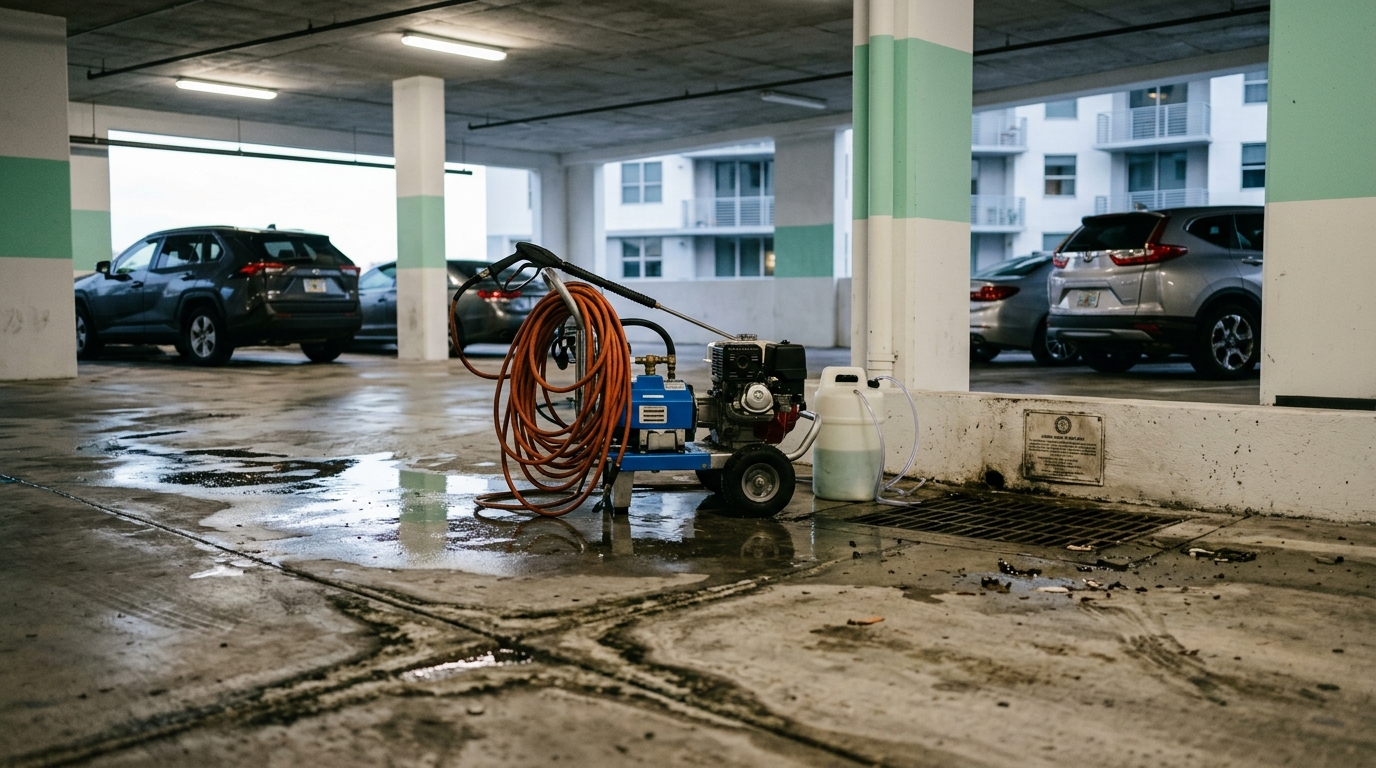
Commercial pressure washing generates wastewater that is regulated at both the county and state level in Florida. Under Miami-Dade DERM (Department of Environmental Resources Management) guidelines, wash water containing detergents, surfactants, oils, or biological matter cannot be allowed to enter storm drains, which in Miami-Dade drain directly to Biscayne Bay and coastal waters. Violations carry fines starting at $500 per incident and escalating to $10,000 for repeat offenders or large-volume discharge events.
In practice, compliance requires one or more of the following containment strategies:
Building owners hiring a commercial pressure washing contractor in Miami should verify that the contractor carries pollution liability insurance in addition to general liability. A standard general liability policy does not cover environmental discharge claims. This distinction matters when a tenant or neighboring property files a complaint with DERM.
For high-rise buildings above four stories, Miami-Dade requires a separate permit for swing stage or aerial lift operations, coordinated through the Building Department. A 2025 code update tightened anchor point inspection requirements for facade work above 40 feet, so any contractor quoting upper-floor pressure washing should reference their compliance plan for those requirements before work begins.
Miami's wet season (June through October) delivers 70% of the region's annual rainfall, with afternoon thunderstorms averaging 60 inches of cumulative precipitation per year. The dry season (November through May) brings lower humidity, reduced biological growth rates, and longer windows of clear weather for exterior work.
The optimal annual maintenance schedule for most commercial properties in Miami follows this pattern:
Properties within two miles of the coast, particularly in Miami Beach, Bal Harbour, Aventura, and Brickell waterfront corridors, should add a quarterly salt deposit removal cycle. Salt crystallization on concrete, stucco, and metal surfaces accelerates corrosion and paint adhesion failure at a measurable rate. A 2024 Florida Building Research study found that coastal commercial properties without regular salt removal required exterior repainting 18–24 months earlier than comparable inland properties on similar paint systems.
Pressure washing is not a standalone service for buildings approaching their repaint cycle. It is preparation. Applying exterior paint over contaminated or damp surfaces in Miami's climate guarantees premature peeling, usually within 12–18 months, compared to a 5–7 year service life from a properly prepared substrate.
After pressure washing stucco or block, the surface needs 48–72 hours of dry time before primer application, even in dry-season conditions. Miami's ambient humidity means that surfaces that look dry on the face may retain moisture in the substrate, particularly on north-facing walls that receive less direct sun. Contractors using a moisture meter (readings below 15% for stucco, below 12% for wood trim) before coating are following industry-standard protocol and will produce more durable results.
For exterior building painting in Miami, elastomeric coatings rated for 100% elongation are the professional standard on stucco because they bridge hairline cracks that appear seasonally from thermal movement. Standard flat or satin latex applied over stucco without an elastomeric component will show cracking at the same locations within two to three wet seasons. On concrete block, a masonry primer with an alkali-resistant formulation is required before topcoat to prevent saponification, a chemical reaction between paint binders and high-pH concrete that causes blistering.
Reactive maintenance on commercial buildings in Miami costs 3–4 times more per square foot than scheduled preventive care. Stucco replacement runs $12–$22 per square foot installed in 2026 pricing. A pressure wash and spot repair program that catches delamination and cracking before water penetrates behind the substrate costs a fraction of that figure and extends the functional life of the facade by 8–12 years on average.
Apartment managers specifically benefit from scheduled building maintenance in Miami because tenant retention data consistently shows that exterior appearance influences lease renewal decisions. A building with visible mold staining, peeling paint, or discolored concrete communicates neglect before a prospective tenant walks through the door.
Combining pressure washing, exterior painting, and minor masonry repair into an annual or biannual service agreement also reduces mobilization costs. A contractor making a single annual visit to handle all three services costs 20–30% less per task than three separate mobilizations, because crew setup, equipment transport, and inspection time are shared across the scope of work.
Most commercial buildings in Miami benefit from pressure or soft washing twice per year: once in November after the wet season and once in spring before summer rains begin. Coastal properties within two miles of the ocean require quarterly salt removal treatments to prevent accelerated corrosion and paint adhesion failure.
Pressure washing itself does not require a building permit in Miami-Dade, but wastewater containment and discharge are regulated by DERM. Work above four stories using aerial lifts or swing stages requires a separate permit from Miami-Dade Building Department. Always verify your contractor's compliance before work starts.
Pressure washing uses high-volume water force (1,500–4,000 PSI) to mechanically remove dirt and biological growth. Soft washing uses low pressure (under 500 PSI) combined with chemical treatments to kill mold, algae, and bacteria at the root. Soft washing produces results that last 4–6 months on Miami stucco versus 30–45 days from pressure washing alone.
On Miami stucco and concrete block, wait a minimum of 48–72 hours after pressure washing before applying primer. Use a moisture meter to confirm substrate readings below 15% for stucco and below 12% for wood trim before coating. Painting over damp surfaces in Miami's humidity is the primary cause of premature peeling within the first 12–18 months.
Yes. A qualified handyman service in Miami that covers pressure washing, minor stucco patching, caulking, and exterior painting coordination can reduce your total maintenance cost by 20–30% compared to hiring separate contractors for each task. Look for a provider that offers a one year warranty on repair work and same day repair response for urgent issues like active water intrusion or damaged entry facades.
Call us today or fill out the form and we'll call you back within 2 business hours. Plans start at $69.99/mo.
1-833-426-3942