
Homeowner Tips & Guides
Miami's humidity tops 75% year-round, putting every home at risk of costly mold damage. This guide covers practical miami humidity control strategies, from HVAC management to the right building materials for South Florida conditions.
Miami's average relative humidity stays above 75% for most of the year, and indoor surfaces only need to reach 60% relative humidity to support active mold growth. That single fact drives every material choice, HVAC decision, and maintenance schedule in a South Florida home. Mold is not a cosmetic problem: the CDC links chronic mold exposure to respiratory illness, and remediation costs in Miami regularly run $3,000–$15,000 depending on affected square footage. Prevention is always cheaper than removal.
This guide covers the specific mechanics of miami humidity control, from how your AC system manages moisture to which building materials resist fungal colonization and which ones invite it.
Moisture enters a Miami home through four main pathways: infiltration through the building envelope, vapor diffusion through walls, plumbing condensation, and occupant activity like cooking, showering, and breathing. In South Florida, infiltration is the dominant pathway because the temperature difference between the humid outdoor air and the cool indoor air creates strong vapor pressure that drives moisture inward through every crack, gap, and unsealed penetration.
The areas most prone to hidden moisture accumulation are wall cavities behind bathroom tile, the space beneath kitchen and bathroom sinks, attic decking above poorly insulated ceilings, the underside of carpeting on slab foundations, and the coil and drain pan of any air conditioning unit. A single slow plumbing drip inside a wall cavity can produce visible mold within 48–72 hours in Miami's summer temperatures.
Investing in a quality digital hygrometer is the first practical step. Place one in each major room. Target readings of 45%–55% relative humidity indoors. Readings that consistently exceed 60% require active intervention, not just awareness.
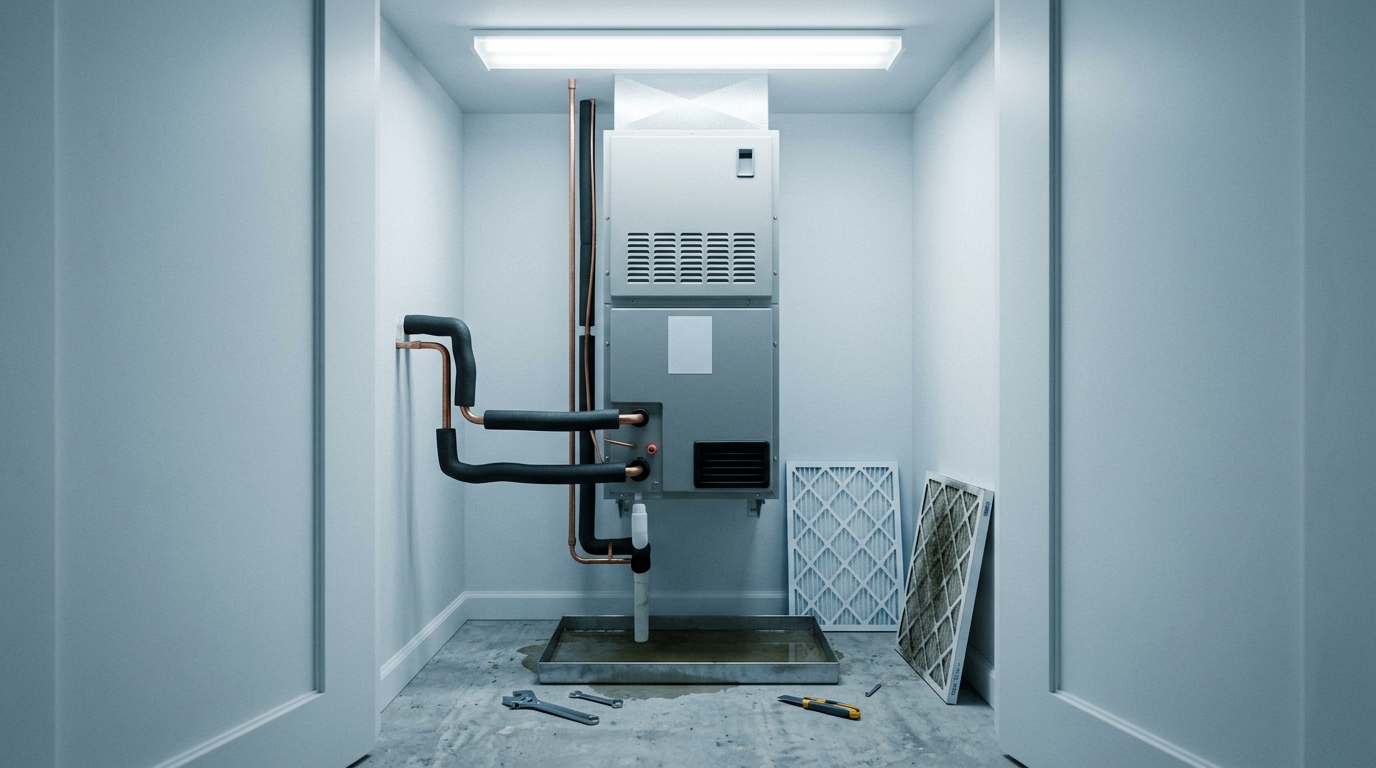
A correctly sized and maintained air conditioning system is the most important humidity control tool in any Miami home. The dehumidification effect is a byproduct of the cooling process: warm humid air passes over a cold evaporator coil, moisture condenses, and the condensate drains away. When the system is oversized for the space, it short-cycles, meaning it cools the air quickly but shuts off before running long enough to remove adequate moisture. The result is a room that feels cool but remains dangerously humid.
For ac dehumidifier performance in a Miami climate, keep these benchmarks in mind:
Same day AC repair matters in Miami because every hour a system is offline during summer means rising indoor humidity. If your AC stops cooling properly, schedule service immediately rather than waiting to see if the problem resolves. A unit running but not dehumidifying effectively (often caused by a refrigerant leak reducing coil temperature) is almost as problematic as one that is fully offline.
Flooring selection is one of the most permanent moisture-management decisions a homeowner makes. The wrong material traps moisture under its surface, feeds mold colonies invisibly, and eventually requires full replacement. The comparison below covers the flooring types most commonly installed in South Florida.
| Flooring Type | Moisture Resistance | Mold Risk | Best Use in Miami Homes |
|---|---|---|---|
| Porcelain or Ceramic Tile | Excellent | Very Low (grout lines need sealing) | Entire home; ideal on slab foundations |
| 100% Luxury Vinyl Plank (LVP) | Excellent | Very Low | Bedrooms, living areas, light commercial |
| Engineered Hardwood | Moderate | Low to Moderate (depends on installation) | Interior rooms with consistent AC; avoid bathrooms |
| Solid Hardwood | Poor | High | Not recommended for Miami's climate |
| Wall-to-Wall Carpet | Very Poor | Very High | Not recommended on slab; unavoidable cases require vapor barrier |
| Laminate (wood-core) | Poor | High (core swells and molds) | Not recommended; use LVP as substitute |
When installing any flooring over a concrete slab, test for slab moisture first using an ASTM F2170 in-situ probe test. Miami slabs routinely emit moisture at levels that exceed the adhesive or underlayment tolerances specified by flooring manufacturers. Skipping this test voids most flooring warranties and frequently leads to mold growth at the adhesive layer within 12–18 months.
Beyond flooring, every material selection in a Miami home should account for moisture exposure. Standard paper-faced drywall is the most common substrate for mold in South Florida homes. Replacing it with fiberglass-faced or cement-based board in bathrooms, laundry rooms, and any wall that backs an exterior exposure eliminates the organic food source that mold colonies need to establish.
For interior paint, use a mold-inhibiting formula with a mildewcide additive in all bathrooms, kitchens, and utility spaces. Standard flat or eggshell finishes absorb moisture; semi-gloss and gloss finishes on walls and ceilings allow surface moisture to shed rather than soak in.
Insulation choices matter equally. Open-cell spray foam, while cost-effective, absorbs and holds moisture if the building envelope is breached. In Miami, closed-cell spray foam is the preferred choice for exterior wall cavities and roof decks because it creates a vapor barrier with an R-value of approximately 6.5 per inch, and it does not hold liquid water against structural framing.
Grout lines in tile installations should be sealed with a penetrating epoxy or polyurethane sealer annually. Unsanded grout is porous enough to absorb moisture and harbor mold even when the tile surface itself remains dry.
Mechanical ventilation removes moisture at the source before it disperses through the home. Every bathroom should have an exhaust fan rated for at least 1 CFM per square foot of floor area, vented directly to the exterior (not into the attic). Run the fan during every shower and for 20 minutes after. Kitchen range hoods should also vent to the exterior; recirculating hoods filter grease but return all the steam directly back into the living space.
Attic ventilation is critical in Miami. A poorly ventilated attic traps heat and moisture, drives up indoor humidity through the ceiling plane, and creates ideal mold conditions on roof sheathing. Ridge and soffit venting should provide a minimum net free area of 1 square foot per 150 square feet of attic floor, per the 2021 International Residential Code.
Daily habits that reduce indoor moisture load include drying laundry in a dryer vented to the exterior (never air-drying indoors), running the AC fan continuously rather than on auto during high-humidity days to keep air circulating across the coil, and keeping interior doors open to prevent localized humidity pockets in closed rooms.
Visible mold covering more than 10 square feet requires professional remediation under EPA guidelines, not a DIY bleach wipe-down. Bleach kills surface mold but does not penetrate porous materials, and improper handling can spread spores to previously clean areas. A licensed mold assessor provides air quality testing and a written protocol before remediation begins.
For HVAC issues, same day repair prevents the humidity escalation that follows any system failure in South Florida's summer months. A qualified miami electrician should inspect the electrical connections at the air handler and condenser annually, since moisture and salt air corrode terminals and can cause intermittent failures that are harder to diagnose than complete breakdowns. Many handyman services also offer preventive AC maintenance packages that include coil cleaning, drain flushing, and filter replacement on a scheduled basis, which reduces emergency callout frequency significantly.
Keep indoor relative humidity between 45% and 55%. Mold growth becomes likely at 60% and above. In Miami, maintaining this range requires a properly sized and maintained central air conditioning system, and in many cases a supplemental whole-home dehumidifier during the June through October rainy season.
Flush condensate drain lines every three months in Miami. The combination of warm indoor temperatures and constant condensation creates ideal conditions for algae and biofilm buildup. A clogged drain causes pan overflow, which saturates surrounding drywall and can produce mold within 48 hours.
100% luxury vinyl plank is among the best flooring options for high humidity because its core contains no wood fiber and is completely waterproof. Porcelain tile is equally resistant and more durable under heavy traffic. Engineered hardwood is acceptable with consistent climate control. Solid hardwood, laminate, and wall-to-wall carpet over slab are all high-risk choices in Miami's climate.
A window unit dehumidifies only the room it is installed in and only when it is actively running. It cannot address vapor pressure moving through walls from adjacent spaces. For whole-home humidity control, a central ducted system sized with a Manual J calculation and supplemented by a ducted dehumidifier delivers reliable results that a window unit cannot match.
Signs of hidden wall mold include a persistent musty odor that is strongest near baseboards or outlets, visible staining or bubbling on drywall surfaces, and occupants experiencing allergy-like symptoms that improve when they leave the building. A certified mold assessor can confirm hidden mold using thermal imaging cameras and air sampling without requiring destructive inspection in most cases.
Call us today or fill out the form and we'll call you back within 2 business hours. Plans start at $69.99/mo.
1-833-426-3942