
Homeowner Tips & Guides
Miami's heat, humidity, and salt air accelerate grout erosion, terrazzo damage, and tile discoloration. This guide covers the essential flooring care routines every Miami property owner needs to protect their investment year-round.
Miami properties require specific flooring maintenance routines because the city's humidity, heat, and salt air accelerate grout degradation, terrazzo erosion, and tile discoloration faster than in drier climates. Proper care extends floor life by 10–20 years and protects property values for homeowners, apartment managers, and service professionals alike.
Whether you manage a Brickell high-rise, a Coral Gables home, or a South Beach vacation rental, understanding the differences between tile, flooring, and terrazzo maintenance prevents costly replacements and keeps your property looking its best year-round.
Miami averages 80–90% relative humidity during summer months, and average temperatures stay above 77°F for more than half the year. These conditions create three specific problems for interior and exterior floors:
A professional handyman service with experience in South Florida flooring can identify these early warning signs before they require full replacement.
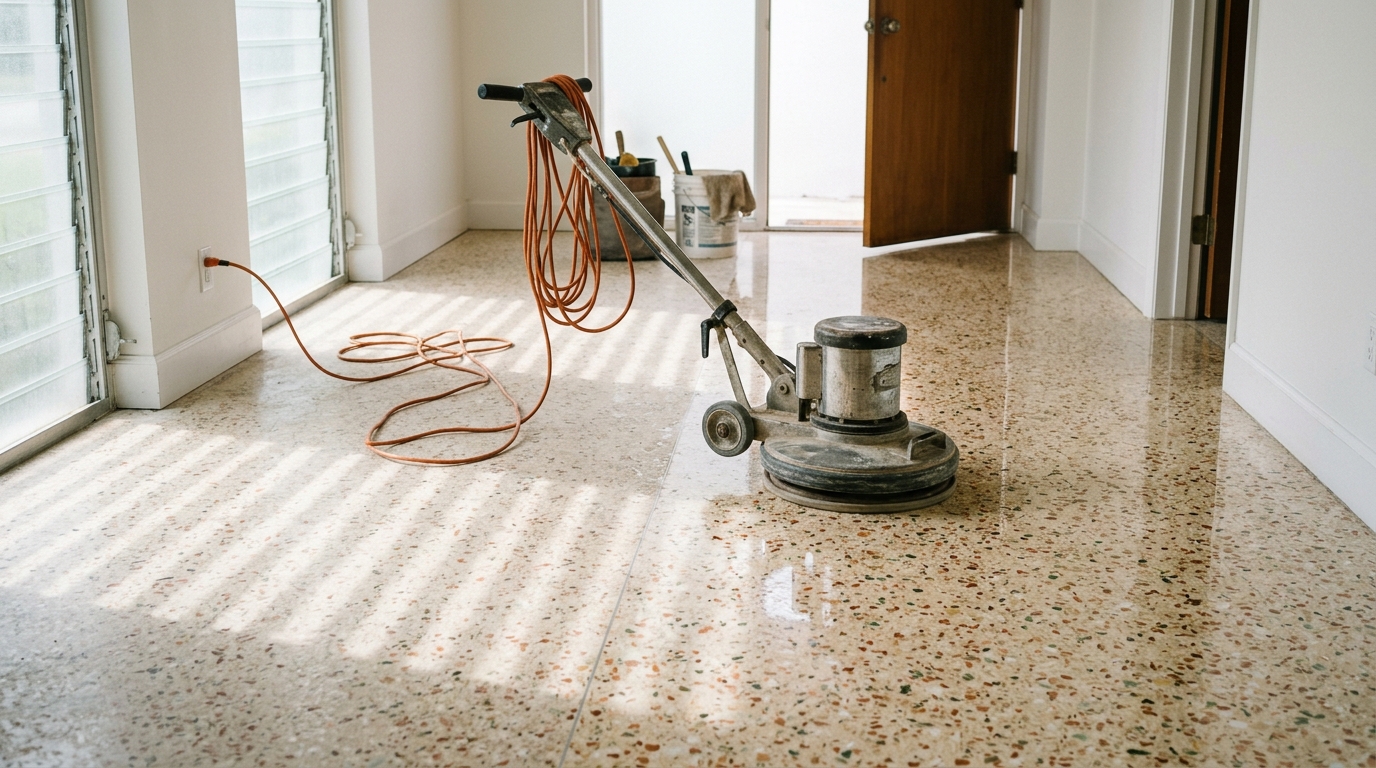
Terrazzo is the defining floor material of Miami's architectural identity, found in Art Deco buildings, mid-century homes, and modern condos throughout Miami-Dade and Broward counties. It is composed of marble chips, glass, or other aggregates set in cement or epoxy binder, then ground and polished to a smooth finish.
Cement-based terrazzo requires a penetrating sealer rated for high-humidity environments. Epoxy terrazzo is non-porous and needs only surface cleaning, but chips and cracks require professional patching with color-matched epoxy to maintain a seamless appearance.
Porcelain tile is the most installed floor type in new Miami construction because its water absorption rate is below 0.5%, making it highly resistant to humidity damage. Ceramic tile absorbs more moisture (up to 3%) and requires more frequent sealing in Miami's wet climate.
| Factor | Tile (Porcelain/Ceramic) | Terrazzo |
|---|---|---|
| Sealing frequency | Grout sealed every 1–2 years | Surface sealed every 12–18 months |
| Crack repair method | Individual tile replacement | Epoxy or cement patching |
| Cleaning agent | Neutral or mild alkaline cleaner | Strictly pH-neutral only |
| Scratch resistance | High (glazed surface) | Moderate (aggregate exposed) |
| Professional polishing | Not typically required | Required every 3–5 years |
Grout is the weakest link in any tile floor. In Miami's humid conditions, unsealed grout absorbs moisture within 30–90 days of installation and begins to harbor mold colonies. The repair sequence for neglected grout is straightforward:
A qualified same day handyman can complete grout sealing for a standard bathroom or kitchen floor in 2–4 hours, protecting the tile investment for the following 12–24 months.
Solid hardwood flooring is rarely the right choice for Miami ground-floor installations due to humidity-driven expansion and warping. Engineered hardwood performs better because its cross-ply construction resists expansion, but it still requires indoor humidity control below 60% to maintain dimensional stability.
Luxury vinyl plank (LVP) has become the dominant replacement flooring choice for Miami apartments and rental units because it is 100% waterproof, dimensionally stable across temperature ranges, and significantly less expensive to install and repair than hardwood or terrazzo restoration.
Miami pool decks and outdoor patios face the harshest combination of UV exposure, salt air, standing water, and pool chemicals. Outdoor tile selection and maintenance must account for:
Not every flooring issue requires a specialty contractor. A skilled handyman near me can handle grout sealing, caulk replacement around tile edges, individual tile replacement, vinyl plank repair, and minor terrazzo patching. These are same day repair jobs that protect against larger damage at a fraction of specialty contractor pricing.
Engage a flooring specialist for full terrazzo restoration (diamond grinding and polishing), large-scale tile replacement covering more than 100 square feet, subfloor repair, or engineered hardwood refinishing. The distinction saves property owners significant cost while ensuring the right expertise applies to the right problem.
Look for a service that backs its work with a one year warranty on labor. This protects your investment and confirms the technician stands behind the repair method used.
Cement-based terrazzo floors in Miami should be resealed every 12–18 months due to high humidity and foot traffic. Epoxy terrazzo is non-porous and does not require sealing, but it should be professionally inspected annually for chips or surface wear that allow moisture infiltration at the binder layer.
Luxury vinyl plank (LVP) is the most practical choice for Miami rental units. It is 100% waterproof, withstands the 80–90% humidity common during summer months, handles tenant foot traffic without refinishing, and costs significantly less per square foot to install and repair than terrazzo restoration or hardwood alternatives.
A professional handyman can replace individual cracked tiles and regrout the surrounding area as a same day repair service. If the crack pattern spans 10 or more tiles in a single area, that signals a subfloor or foundation issue that requires a structural inspection before any tile replacement proceeds.
Unsealed grout in Miami absorbs airborne moisture within weeks, creating a continuously damp environment where mold and mildew colonies establish quickly. The solution is thorough mold treatment followed by two coats of a penetrating grout sealer applied to fully dry grout. Resealing annually in humid interior spaces like bathrooms eliminates recurring black grout discoloration.
Yes. Properties within 1 mile of the Miami coastline experience elevated salt air concentration that accelerates grout erosion and tile surface degradation. Outdoor pool and patio tile in these areas should be inspected and resealed every 6–12 months. Efflorescence treatment should be applied annually before resealing to remove mineral salt deposits that trap moisture under the sealer coat.
Call us today or fill out the form and we'll call you back within 2 business hours. Plans start at $69.99/mo.
1-833-426-3942