
Homeowner Tips & Guides
A smart thermostat is just the start. Learn the five home automation upgrades that cut Miami electric bills most, from zoned dampers to humidity control, and when to call a licensed pro.
The five home automation upgrades that cut Miami electric bills most are a smart thermostat, zoned AC dampers, a smart humidity controller, smart plugs and power monitoring for AC-adjacent loads, and a variable-speed air handler with connected controls. Homes that combine two or three of them typically see cooling costs fall 10–20%, because AC accounts for roughly half of a South Florida household's electricity use.
Miami's challenge is not only heat. Outdoor dew points sit in the 70s from May through October, so your AC spends much of its runtime removing moisture, not just lowering temperature. The upgrades below target both jobs. Each section covers how it works, what it costs to get wrong, and where a licensed professional needs to be involved.
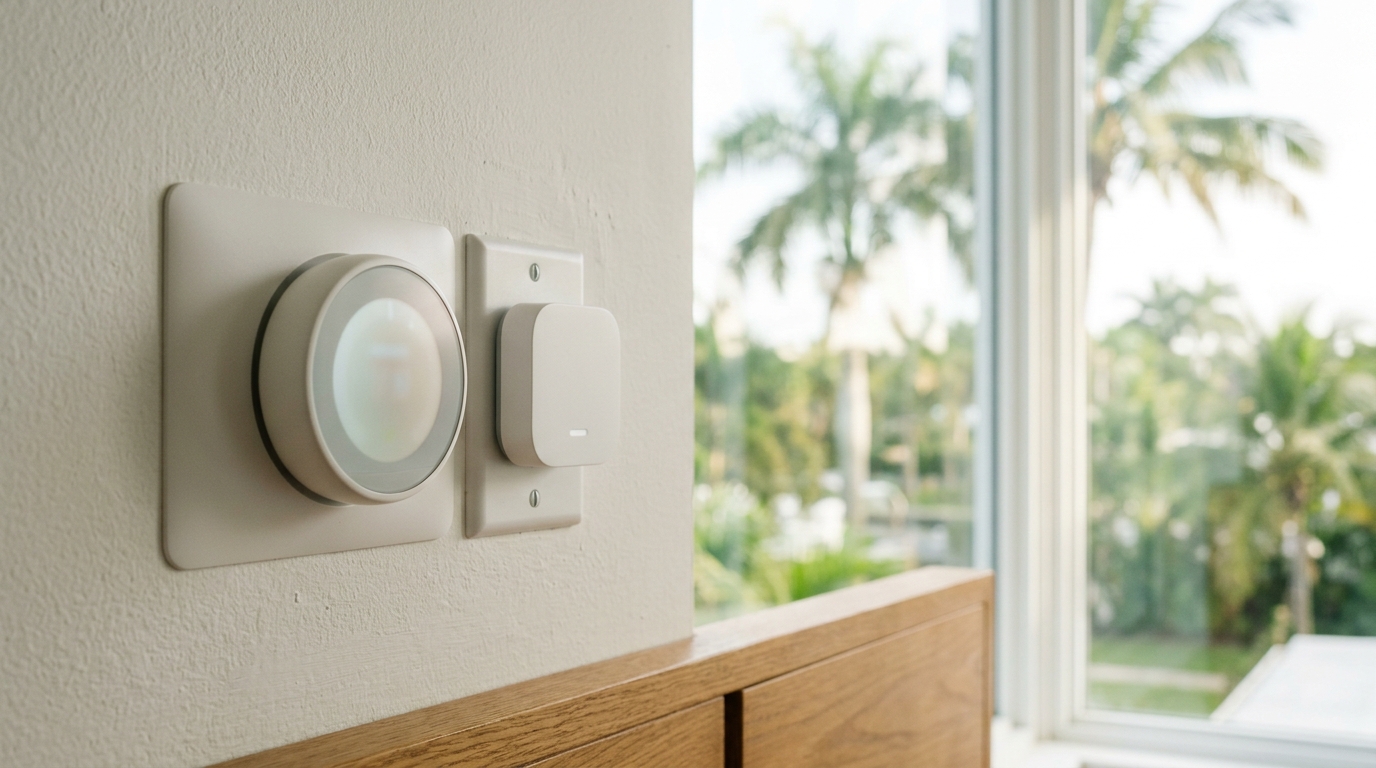
A smart thermostat such as the Google Nest Learning Thermostat, Nest Thermostat, ecobee Smart Thermostat Premium, or Honeywell T9 learns your schedule, adjusts setpoints when you are away, and reports runtime data. ENERGY STAR estimates certified smart thermostats save an average of 8% on heating and cooling costs. In Miami, where cooling runs nearly year-round, that gain adds up faster than in cooler climates.
Installation details matter more than brand. Many Miami homes, especially condos and older single-family houses, lack a C-wire (common wire) that supplies continuous 24V power. Without it, a thermostat may drain power from the AC control board, causing short cycling or random shutoffs. A professional Nest installation in Miami includes checking for the C-wire, installing a power adapter kit if needed, and confirming the wiring matches your equipment: single-stage, two-stage, or heat pump with reversing valve.
Settings that save the most in humid climates:
Most Miami homes cool every room to the same temperature from one thermostat, even when a west-facing bedroom bakes in the afternoon and a guest room sits empty. Zoning splits ductwork into independent areas, each with a motorized damper and its own sensor. Systems like Honeywell TrueZONE, Arzel, and Carrier Infinity zoning let the AC deliver air only where it is needed.
Trade-offs to understand before buying:
For apartment managers, scheduling separate handlers in vacant units to a higher setpoint is one of the simplest ways to control common-area and turnover costs.
In Miami, comfort depends on keeping indoor relative humidity between 45% and 55%. An oversized or single-speed AC cools the air fast, satisfies the thermostat, and shuts off before removing enough moisture. The result is a cold, clammy house and a higher bill as occupants lower the setpoint to feel comfortable.
Two connected solutions address this:
A whole-home dehumidifier uses roughly 500–700 watts while running, far less than the extra AC runtime needed to chase humidity by overcooling. Proper installation requires a condensate drain and electrical connection, so hire a licensed pro. A persistent humidity reading above 60% with the AC running often points to a dirty coil, low refrigerant, or an oversized unit, which needs diagnosis, not just a gadget.
You cannot cut what you do not measure. A whole-panel energy monitor such as Emporia Vue or Sense installs in your electrical panel with clamp sensors on the main feeders and on the AC breaker. It shows live and historical consumption by circuit. Homeowners often discover that an aging compressor draws 20–30% more than it did when new, a clear signal for a service call before a failure.
Useful applications:
Panel work should be handled by a licensed Miami electrician. Never install clamp sensors or surge devices inside a live panel without proper qualifications.
If your AC is 12 or more years old, a smart thermostat will help, but the equipment limits the savings. Modern variable-speed systems (Carrier Infinity, Trane XV20i, Lennox SL28XCV) modulate compressor and blower output between roughly 25% and 100%. They run longer at low speed, which improves dehumidification and cuts energy use. Current federal minimums in the Southeast require at least 14.3 SEER2 for split systems, and high-efficiency models reach 20+ SEER2.
Pair the equipment with its manufacturer's communicating thermostat to unlock features a generic smart thermostat cannot reach: staged capacity control, built-in humidity management, and diagnostic alerts sent to your contractor. Before replacing, have a technician perform a load calculation (Manual J). Oversizing is common in South Florida and defeats the purpose of efficient equipment.
| Upgrade | Best For | Main Benefit | Pro Installation Needed |
|---|---|---|---|
| Smart thermostat | Any home with central AC | Scheduling, runtime data, about 8% savings | Yes, for C-wire and wiring checks |
| Zoning or room sensors | Two-story or large homes | Even temperatures, less wasted cooling | Yes, for dampers; sensors are DIY-friendly |
| Whole-home dehumidifier | Homes with humidity above 55% | Comfort at higher setpoints | Yes, for ducting, drain, and wiring |
| Power monitoring and surge protection | Older AC units, storm-prone areas | Early fault detection, equipment protection | Yes, for panel work |
| Variable-speed AC with connected controls | Systems 12+ years old | Largest efficiency and humidity gain | Yes, full HVAC installation |
Start with maintenance: a clean coil, correct refrigerant charge, and sealed ducts. Automation on top of a struggling system only reports the problem. Then add a properly wired smart thermostat, followed by humidity control or zoning based on what your home actually shows. If you need a AC repair near me visit first, ask the technician to check static pressure and coil condition at the same time. Our team offers Same Day Repair scheduling and backs installations with a One Year Warranty, so wiring, thermostat, and electrical work are covered together.
ENERGY STAR reports an average of 8% savings on heating and cooling. For a Miami home spending $200 a month on cooling, that is about $16 monthly, or nearly $200 a year, with higher savings for homes that are often empty during the day.
Often yes. The Nest Learning Thermostat can run on power-stealing in some setups, but many Miami systems need a C-wire or a power adapter to avoid short cycling and battery drain. A technician tests the existing wiring before installing.
Keep relative humidity between 45% and 55%. Levels above 60% promote mold and dust mites, and levels below 30% cause discomfort and wood damage.
No. Most work with standard 24V systems, but line-voltage equipment, some ductless mini-splits, and proprietary communicating systems need specific controllers. Confirm compatibility before purchase.
If the system is under 10 years old and runs properly, smart controls deliver the best return. If it is 12+ years old, needs frequent repairs, or cannot control humidity, a variable-speed replacement with connected controls saves more over its life.
Call us today or fill out the form and we'll call you back within 2 business hours. Plans start at $69.99/mo.
1-833-426-3942