
Homeowner Tips & Guides
The right paint, flooring, and fixtures make Miami humidity control far easier. Learn which materials resist mold and moisture, and how to pair them with an AC that holds 45% to 55% humidity.
The best materials for high-humidity Miami homes are 100% acrylic or 100% acrylic-latex paint with mildewcide, porcelain tile or rigid-core luxury vinyl plank flooring, and stainless steel (316 grade) or solid brass fixtures. Pair them with an AC system that holds indoor relative humidity between 45% and 55%, and mold has little room to grow.
Miami's average relative humidity runs roughly 70–80% year-round, and dew points stay above 70°F for much of the May–October wet season. Mold spores germinate on organic surfaces when indoor humidity stays above 60% for 24–48 hours. Drywall paper, wood subfloors, and cabinet backing all qualify as food sources.
Humidity enters a home three ways: infiltration through gaps and unsealed penetrations, moisture from cooking, showers, and laundry, and vapor drive through porous walls and slabs. Material choices address the third path. Your AC and sealing address the first two.
Paint is your first moisture barrier. Choose by binder type and sheen, not brand alone.
Never paint over visible mold. Clean the surface with a detergent solution, let it dry fully, and confirm the moisture source is fixed first. Painting over active growth traps it and the peeling returns within months.
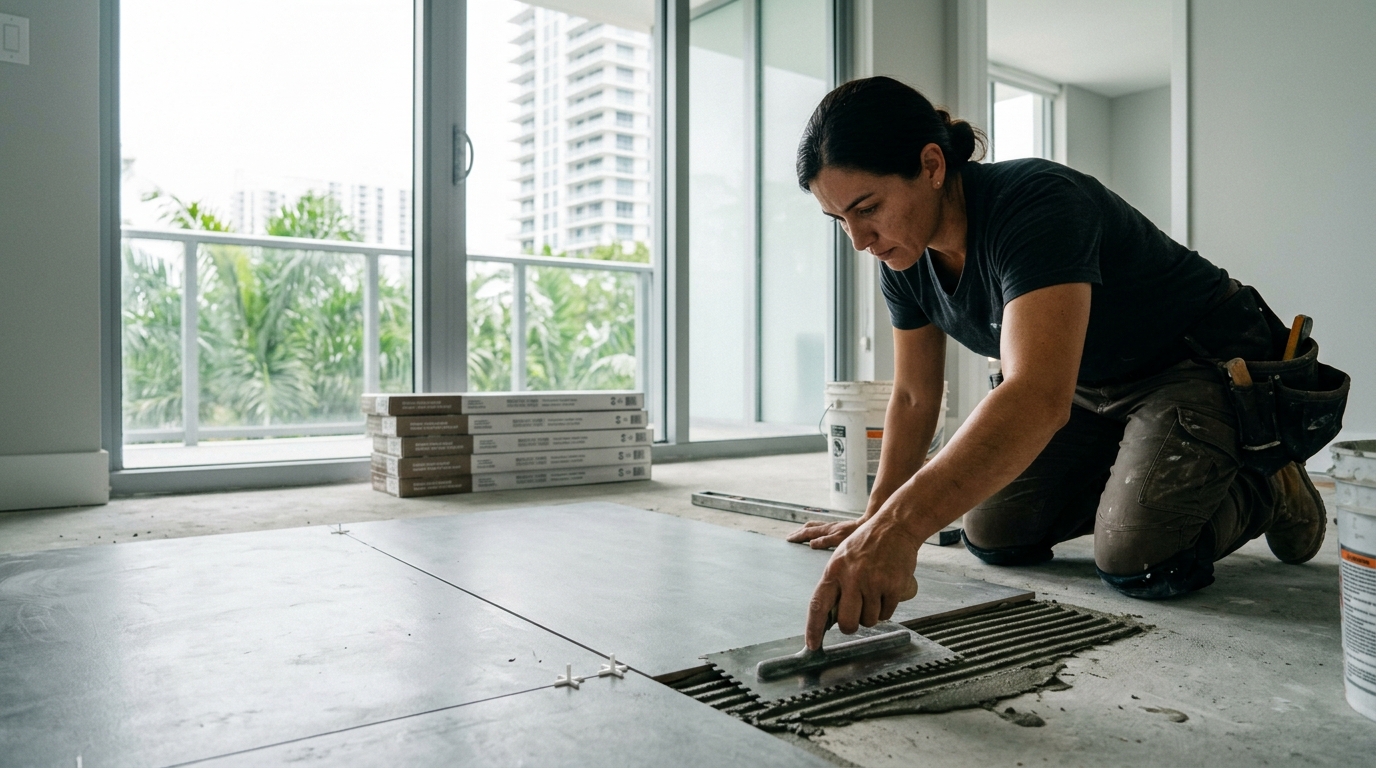
The best flooring for high humidity is porcelain tile, followed by rigid-core luxury vinyl plank (LVP). Both tolerate moisture swings that warp solid hardwood and swell laminate.
| Flooring | Humidity Performance | Main Trade-Off |
|---|---|---|
| Porcelain tile | Water absorption under 0.5%; excellent | Grout needs sealing; cold and hard underfoot |
| Rigid-core LVP (SPC or WPC) | Waterproof core; very good | Can trap moisture if installed over a damp slab without a barrier |
| Engineered hardwood | Moderate; more stable than solid | Needs consistent 40–55% indoor humidity |
| Solid hardwood | Poor; cups, gaps, and buckles | Not recommended on or near a slab |
| Standard laminate | Poor; fiberboard core swells at edges | Unrepairable once water-damaged |
Concrete slabs release moisture vapor continuously. Before installing any floor, run a calcium chloride or in-situ relative humidity test. Most LVP and wood manufacturers void warranties above 75–80% slab RH or above 3–5 lbs of moisture emission per 1,000 sq ft per 24 hours. Where readings run high, install a vapor barrier or epoxy moisture mitigation coating first.
For tile, use epoxy or high-performance urethane grout in showers and entries. Cement grout is porous and darkens with mildew even when sealed annually.
Salt-laden air and constant moisture corrode cheap metals fast, especially within a few miles of Biscayne Bay and the coast.
Your air conditioner is the primary dehumidifier in your home. It removes moisture as warm air crosses the cold evaporator coil, and the water drains out through the condensate line. Maintenance failures here are the most common cause of indoor humidity problems.
When the AC alone cannot keep up, a whole-home dehumidifier (typically 70–120 pints per day capacity) ducted into the air handler is the standard fix. It works independently of cooling, which matters in spring and fall when the AC cycles less. For an ac dehumidifier Miami setup, a licensed technician should integrate it with your existing ductwork and drain. Our air conditioning service covers inspection, cleaning, and humidity diagnostics with Same Day Repair availability.
Many of these tasks fit under routine handyman services, including resealing, fan replacement, and repainting with mold-resistant coatings. Electrical items such as fan wiring, GFCI upgrades, and corrosion repair call for a licensed Miami electrician.
Spending more on the right material costs less than replacing the wrong one. Replacing a swollen laminate floor in a 400 sq ft living area often runs several thousand dollars, while the cost difference between laminate and rigid-core LVP is typically a small fraction of that. Ask any contractor for workmanship coverage in writing. Our work includes a One Year Warranty, so installation defects are corrected without added cost.
Keep indoor relative humidity between 45% and 55%. Mold growth accelerates above 60%, so a hygrometer in the main living area and bathrooms gives you an early warning.
Porcelain tile is the best performer, with rigid-core luxury vinyl plank a close second. Avoid solid hardwood and standard laminate, especially over concrete slabs.
Yes. The evaporator coil condenses moisture from the air as it cools. It only works well when the system is correctly sized, the filter and coil are clean, and the condensate drain flows freely. Add a whole-home dehumidifier if humidity stays above 55% with a healthy AC.
Use a 100% acrylic satin or semi-gloss paint labeled mildew-resistant, applied over a mold-resistant primer. Pair it with an exhaust fan rated at least 50 CFM.
Many AC, drain-line, and fan issues qualify for Same Day Repair when you call in the morning. Search for AC repair near me or a same day handyman, and confirm the provider is licensed and insured before work begins.
Call us today or fill out the form and we'll call you back within 2 business hours. Plans start at $69.99/mo.
1-833-426-3942