
Homeowner Tips & Guides
Outdoor smart lighting in Miami runs roughly $150–$400 per fixture location installed. Learn how to choose switches, bulbs, and outlets that survive salt air, humidity, and storms while boosting security and ambiance.
Outdoor smart lighting for a Miami home costs roughly $150–$400 per fixture location installed, and a licensed electrician should handle any new wiring, weatherproof switch, or GFCI outlet. Done correctly, it adds security through motion-triggered and scheduled lighting, extends usable patio hours, and holds up against salt air, humidity, and hurricane-season storms.
Miami's climate shapes every product and wiring decision. Year-round humidity, salt-laden air near Biscayne Bay and the coast, intense UV, and summer thunderstorms break down cheap fixtures and unprotected connections quickly. Smart lighting adds a control layer on top of the electrical system, so the fixtures, wiring, and enclosures underneath must be rated for wet locations.
The practical benefits fall into three groups:
The first planning decision is where the "smart" lives. Each approach has trade-offs, and many Miami homes combine two of them.
| Option | Best For | Main Limitation |
|---|---|---|
| Smart switch | Existing porch, garage, and landscape circuits | Needs a neutral wire and proper box installation |
| Smart bulb | Color changing accents on lanterns and patio sockets | Fails if someone flips the wall switch off |
| Smart outdoor outlet or plug | String lights, pool pumps, and fountain lighting | Plug-in units must be rated for wet locations |
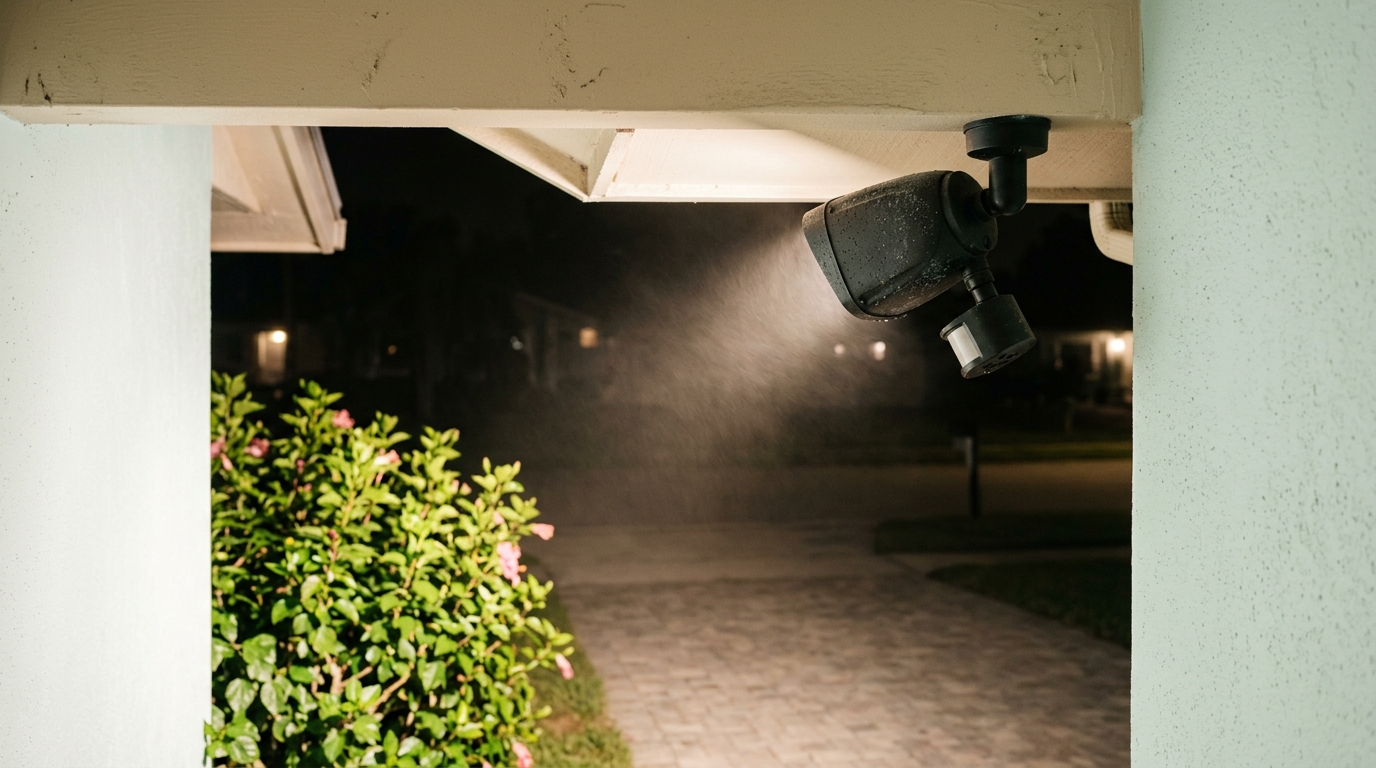
| Smart motion floodlight | Side yards, driveways, and entry points | Placement and sensitivity need tuning |
For permanent exterior lighting, a smart switch is usually the stronger choice. It controls any compatible LED fixture, works with the existing fixture, and keeps manual control for guests and family members. Smart bulbs suit decorative accents where color matters more than reliability.
Good outdoor lighting is designed in layers rather than placed at random. Plan each zone separately and assign it a purpose.
Place motion-activated fixtures at the front door, garage, side gates, and any dark corner of the yard. Mount them 8–10 feet high and angle them downward to reduce glare and false triggers from palm fronds. Set sensitivity so that small animals do not trigger the light every night, and set timers to 1–5 minutes after motion stops.
Steps, walkways, and pool decks need low, even light. Warm white LEDs between 2700K and 3000K are comfortable for the eye and less attractive to insects than cool white. Low-voltage path lights on a smart transformer are inexpensive and safe near wet areas.
Uplights on trees, wall washers on stucco, and lights under outdoor seating create depth. Use dimmable fixtures and group them into scenes such as "Dinner," "Party," and "Away" so you control the whole yard from one tap.
The smart device is the easy part. The wiring behind it decides whether the system lasts. Several requirements apply to outdoor work in Florida:
Permits may apply to new circuits or panel changes in Miami-Dade County. A licensed electrician for smart home upgrades handles the permit, inspection, and code details, which protects your insurance coverage and resale value.
Smart devices communicate over Wi-Fi, Zigbee, Z-Wave, Thread, or Bluetooth. For outdoor use, signal range through concrete block walls is the practical concern.
Test signal strength at each fixture location before installing. A phone running a Wi-Fi speed test at the exact spot takes two minutes and prevents repeat visits.
Miami homeowners should plan for storms. Surge protection at the panel and at the transformer protects delicate smart electronics from lightning and grid fluctuations. Set a "Storm" scene that turns on exterior lights if the power flickers, and confirm that devices restore to a known state after an outage. Fixtures near open yards should be anchored with corrosion-resistant fasteners, and plug-in smart outlets should be unplugged and stored before a named storm.
A typical project follows five steps:
Many smart switch installations finish in a few hours, and single-fixture projects often qualify for Same Day Repair or installation service. Larger landscape systems take one to three days. Workmanship is backed by a One Year Warranty, so a failed connection or faulty install gets corrected.
A handyman can swap a like-for-like switch, replace a fixture on an existing box, or mount a plug-in smart outlet. Call an electrician for new circuits, missing neutrals, outdoor receptacles, panel work, transformer wiring, or anything involving permits. If you search for a Miami electrician or a handyman near you, confirm the license, insurance, and warranty terms before work begins. Apartment managers should ask for per-unit pricing when upgrading multiple balconies or common areas.
Expect about $150–$400 per fixture location, including the smart switch or fixture and labor. Full landscape systems with transformers, wiring, and several zones typically run $1,500–$5,000 depending on lot size and wiring complexity.
Yes, but many older homes lack a neutral wire at the switch box. An electrician can add a neutral or install a no-neutral smart switch rated for your LED load.
It is safe when fixtures carry a wet-location rating, boxes are sealed, and hardware is corrosion-resistant. Coastal homes should use stainless steel or marine-grade components.
Yes, if you keep the manual wall switch and choose devices that support local control, such as Zigbee, Z-Wave, or Matter over Thread. Schedules stored on the device continue running without internet.
Swapping switches or fixtures on existing circuits usually does not require one. New circuits, outdoor receptacles, and panel changes typically do, and a licensed electrician pulls the permit.
Call us today or fill out the form and we'll call you back within 2 business hours. Plans start at $69.99/mo.
1-833-426-3942