
Homeowner Tips & Guides
A well-maintained AC removes 15–25 pints of moisture daily, keeping Miami humidity in the safe zone below 60%. This 2026 guide covers AC-driven humidity control, mold prevention, and material selection for South Florida homes.
A properly maintained air conditioning system removes 15–25 pints of moisture from indoor air per day in a typical South Florida home, keeping relative humidity below the 60% threshold where mold colonies begin forming within 24–48 hours. Without that moisture removal, no amount of ventilation, flooring choice, or dehumidifying product will fully protect your home from the structural and health consequences of Miami humidity.
This 2026 guide covers the mechanics of AC-driven humidity control, mold prevention strategies, smart material selection, and when to call for professional AC dehumidifier service in Miami before damage becomes expensive.
South Florida averages relative humidity between 75% and 90% outdoors from May through October. When that moisture infiltrates a home, it does not simply make the air feel uncomfortable. It triggers a chain of physical and biological processes that degrade building materials over months, not years.
Wood subfloors absorb moisture vapor and swell, causing hardwood flooring to cup, buckle, or delaminate at the adhesive layer. Drywall paper facing becomes a food source for mold spores that are always present in outdoor Miami air. Insulation in attics and walls loses its R-value when saturated, forcing your AC to work harder and run longer. Metal fasteners, electrical junction boxes, and HVAC ductwork connections corrode faster in sustained high-humidity environments.
The critical number to remember is 60%. The EPA and ASHRAE both identify indoor relative humidity above 60% as the point where biological growth accelerates. Below 50% is ideal. Your AC system, when properly sized and maintained, is the primary mechanical tool for staying in that safe range.
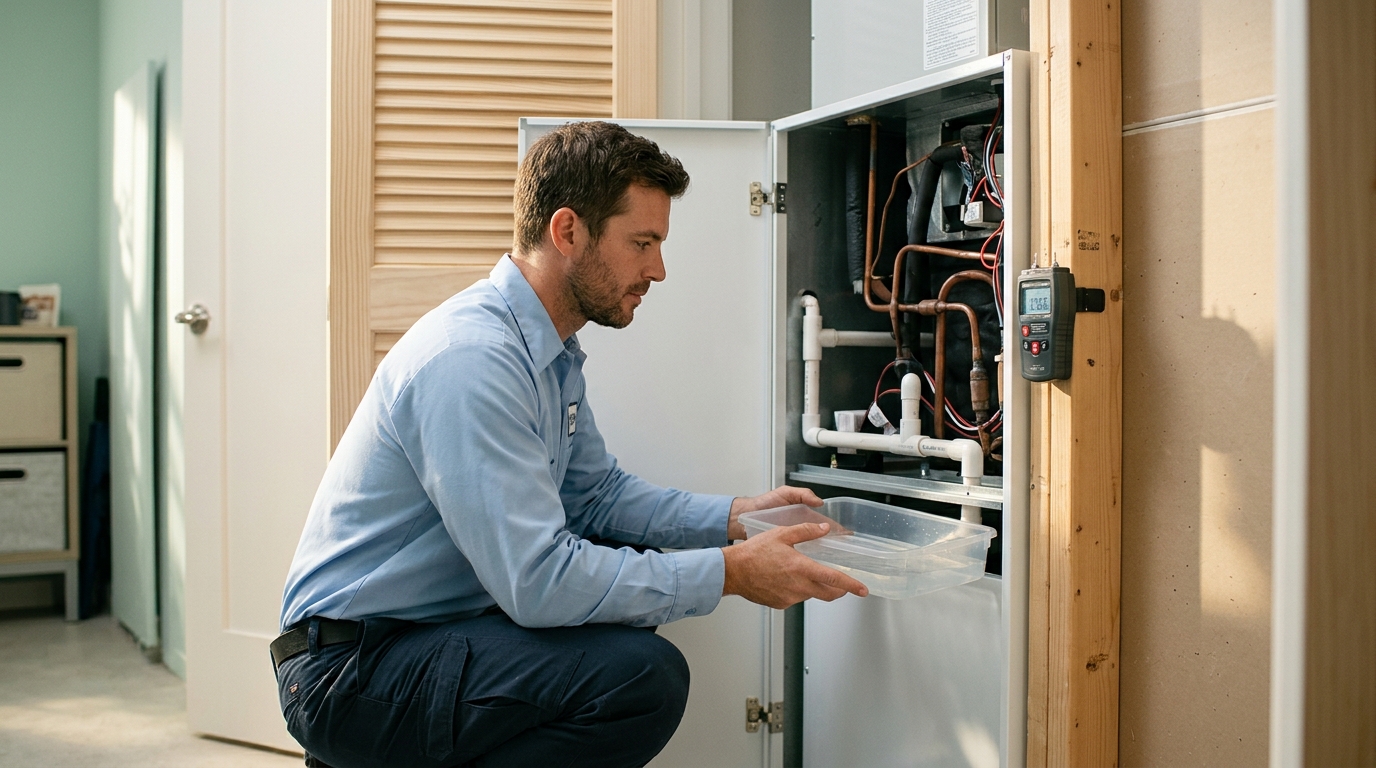
An air conditioner removes humidity through the refrigerant cycle. Warm, humid indoor air passes over the cold evaporator coil; moisture condenses on the coil surface and drains out through the condensate line. The dehumidifying efficiency of that cycle depends entirely on the cleanliness and condition of the system.
A dirty evaporator coil covered in dust and biofilm reduces the coil's surface area available for condensation, cutting moisture removal by as much as 30%. A clogged condensate drain line, one of the most common service calls in South Florida, causes water to back up into the drain pan, overflow onto ceiling drywall, and create an ideal mold environment directly inside the air handler. A refrigerant leak drops the coil temperature inconsistently, so condensation never reaches optimal levels.
For homeowners and apartment managers in Miami-Dade, Broward, and Palm Beach counties, a maintenance schedule that includes the following tasks every 6 months is the minimum standard in 2026:
A same day repair call for any of these issues pays for itself immediately when you compare it to water damage remediation costs, which routinely run $3,000–$12,000 for a single moisture event in a South Florida home.
Standard split-system AC units are designed primarily to control temperature. In high-load humidity conditions, particularly in older Miami homes with single-pane windows, poor vapor barriers, or frequent door traffic, a central AC alone may not drive humidity below 60% during shoulder-season months when cooling demand is low but outdoor humidity remains high.
In those situations, a whole-home dehumidifier integrated into the HVAC duct system is the correct solution. Units from brands like Aprilaire (Model 1850 and 1870) and Santa Fe (Ultra120) are designed for hot, humid climates and can remove 90–120 pints of moisture per day without requiring the air temperature to drop. They operate independently of the AC compressor, which means they continue dehumidifying on mild days when the thermostat never triggers a cooling cycle.
A portable room dehumidifier addresses a single room or closet but does nothing for the rest of the structure. For apartment managers overseeing multiple units, or homeowners with chronic mold in a specific bathroom or bedroom, a targeted portable unit combined with improved ventilation is appropriate. For whole-structure protection, the integrated duct-mounted approach is the professional standard.
Miami humidity control is not a single-point solution. Each area of a home presents different moisture-entry risks and requires a specific response.
Bathrooms: Install an exhaust fan rated at a minimum of 110 CFM for a standard 8x10 bathroom. Run it during showers and for 20 minutes after. Caulk grout lines annually to prevent moisture infiltration behind tile. Inspect the toilet wax ring and supply lines every 12 months since slow leaks feed mold colonies inside wall cavities silently for months before visible signs appear.
Kitchens: Use the range hood every time you cook, especially when boiling water. A pot of pasta produces roughly half a pint of steam in 15 minutes. That moisture rises directly into upper cabinets if the hood is not active. Check the dishwasher door gasket annually since a worn gasket releases steam into the cabinet below the counter during every cycle.
Attics: South Florida attics accumulate heat and humidity that radiates downward. Confirm soffit-to-ridge ventilation is clear and unobstructed. Spray foam insulation at the roof deck (hot roof assembly) eliminates the attic air volume entirely and is increasingly popular in new Miami construction because it removes the attic as a humidity reservoir.
Under-slab and crawl spaces: Many older South Florida homes have a vapor retarder rated at 6-mil polyethylene or higher installed over any exposed soil. Without it, ground moisture migrates directly up through concrete slabs into flooring adhesives and subfloor materials.
Flooring selection is a direct humidity-management decision in South Florida homes. The table below compares the five most common residential flooring materials by their performance in high-humidity environments.
| Flooring Type | Moisture Resistance | Mold Risk | Miami Suitability | Key Trade-Off |
|---|---|---|---|---|
| Porcelain or Ceramic Tile | Excellent (impermeable surface) | Low (grout lines are the risk point) | Highest | Hard underfoot; cold in air-conditioned rooms |
| Luxury Vinyl Plank (LVP) | Very Good (100% waterproof core) | Low if installed with moisture barrier | Very High | Can expand if room temperature swings beyond 65–85°F range |
| Engineered Hardwood | Moderate (plywood core resists cupping better than solid wood) | Moderate | Acceptable with sealed perimeter | Cannot be refinished as many times as solid hardwood |
| Solid Hardwood | Poor (expands and contracts with humidity shifts) | High if humidity exceeds 60% | Low without strict humidity control | Durable and refinishable but requires sustained indoor RH 35–55% |
| Carpet | Poor (retains moisture and organic debris) | Very High | Not recommended | Lowest upfront cost; highest long-term mold remediation risk |
For most Miami homeowners replacing flooring in 2026, luxury vinyl plank over a 6-mil vapor barrier is the practical standard: fully waterproof, comfortable underfoot, and compatible with floating installation that allows expansion without buckling.
AC systems interact with your home's electrical infrastructure in ways that humidity directly affects. Moisture infiltrating electrical panels, junction boxes, or outlet receptacles near exterior walls causes corrosion that trips breakers, creates arc-fault conditions, and in serious cases starts fires inside wall cavities.
If your AC unit fails to start, trips its breaker repeatedly, or the condensate overflow switch cuts the system off, those are same day repair situations. A qualified Miami electrician should inspect any electrical panel located in a garage or utility room that shows rust staining, moisture streaks, or corrosion on breaker faces. GFCI outlets in bathrooms, kitchens, and outdoor areas that trip without an obvious load cause often indicate moisture infiltration into the wiring.
Handyman services that include both electrical and HVAC scope are efficient for apartment managers dealing with multiple units, since moisture problems rarely stay isolated to a single system.
Keep indoor relative humidity between 45% and 55%. Below 45% causes wood furniture and trim to dry and crack in Florida's air-conditioned interiors. Above 60% triggers mold growth within 24–48 hours. A $20–$40 digital hygrometer placed in the main living area gives you a real-time reading so you know when your AC or dehumidifier needs attention.
Twice per year is the professional standard for Miami-Dade, Broward, and Palm Beach counties. Schedule one service in April before peak cooling season and one in October after it. The condensate drain line specifically should be flushed every 6 months since South Florida's heat accelerates algae growth inside PVC drain lines faster than in cooler climates.
An AC with a dehumidifier mode runs the blower at a lower speed to extend air contact with the cold evaporator coil, improving moisture removal during cooling cycles. A dedicated whole-home dehumidifier operates independently of the cooling cycle, removing moisture 24 hours a day regardless of whether the thermostat calls for cooling. Homes with chronic humidity above 60% during mild weather need the dedicated unit because the AC compressor simply does not run often enough on 78°F days to control moisture.
Yes, if your existing flooring is structurally sound. The priority sequence is: maintain AC below 60% relative humidity, seal grout and caulk lines annually, run exhaust fans consistently, and apply a mold-inhibiting primer behind any drywall that shows prior moisture staining. Flooring replacement becomes necessary when moisture has reached the subfloor or adhesive layer, which a handyman or inspector can assess by checking for soft spots, odor, or visible lifting at seams.
Directly, yes. A backed-up condensate line overflows into the drain pan, which overflows onto the ceiling drywall below the air handler, typically within 4–8 hours of the blockage forming. Drywall exposed to standing water begins supporting mold growth within 24–48 hours. A same day repair that clears the line and dries the pan stops that process before remediation becomes necessary. Repairs that wait 2–3 days frequently result in $1,500–$5,000 in drywall and insulation replacement in addition to the service call.
Call us today or fill out the form and we'll call you back within 2 business hours. Plans start at $69.99/mo.
1-833-426-3942