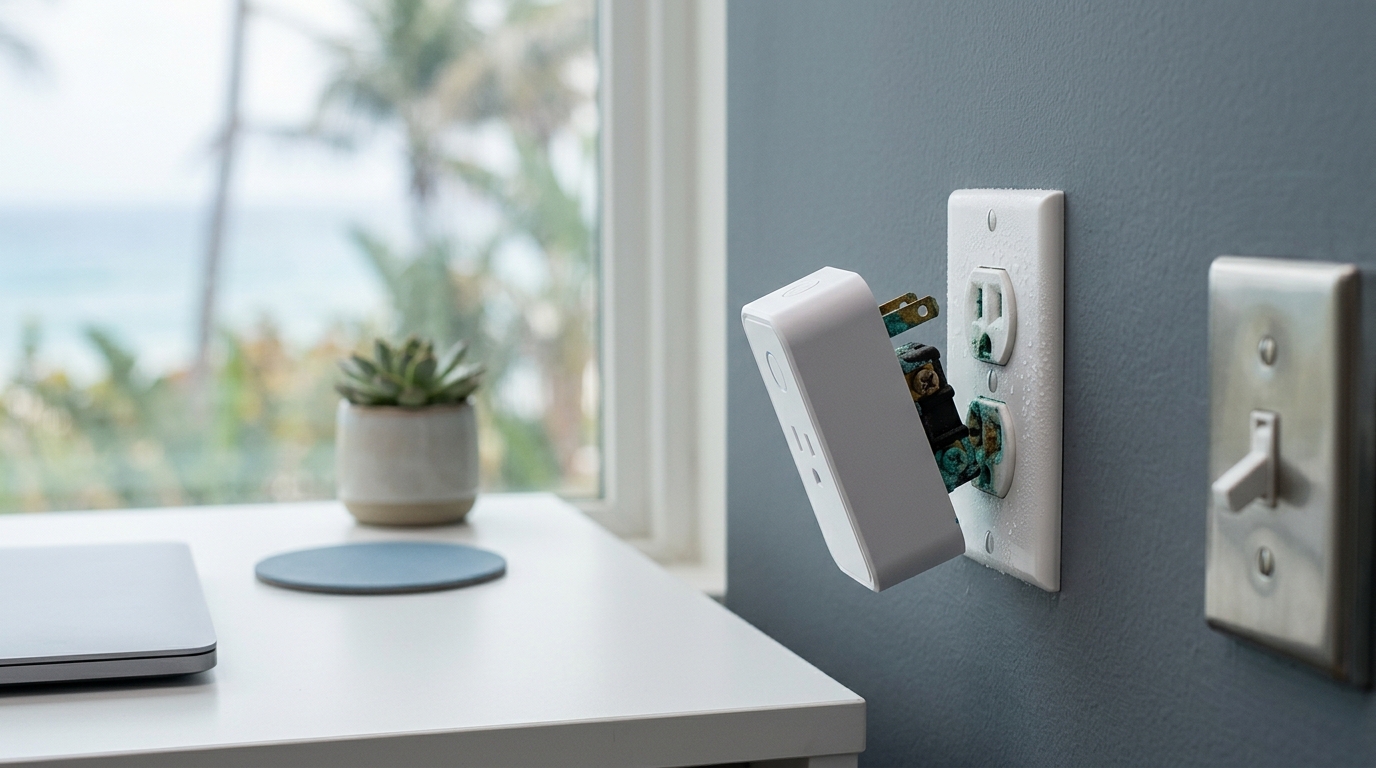
Smart plugs are not a fire hazard when they are UL-listed, rated for the load plugged into them, and installed on a healthy circuit. Fires linked to smart plugs almost always trace back to overloaded ratings, counterfeit units, or damaged outlets behind them. This guide explains where the real risks sit and how Florida homeowners can avoid them.
What Actually Causes Smart Plug Fires
A smart plug is a small relay inside a plastic housing. It passes current through contacts that open and close on command. Heat is the failure mode, and it comes from four sources:
- Overloading the rating. Most plugs are rated 10A or 15A at 120V (1,200 to 1,800 watts). Space heaters, portable air conditioners, and window AC units often draw 12A to 15A continuously, which leaves no safety margin.
- Counterfeit or uncertified units. Bargain plugs with no UL, ETL, or CSA mark often use thin copper and undersized relays that overheat under load.
- Loose or worn receptacles. A plug seated in a loose outlet creates resistance, and resistance creates heat at the contact points.
- Stacking adapters. Plugging a power strip into a smart plug multiplies the load beyond what the relay handles.
The plug itself is rarely the root cause. It is usually the weakest link in an already stressed circuit.
Florida Conditions That Raise the Risk
Miami and South Florida add stressors that mainland guidance often ignores:
- Humidity. Average relative humidity above 70% corrodes contacts and receptacle terminals over time, increasing resistance.
- Salt air. Coastal properties see faster oxidation on outdoor outlets and fittings.
- Heavy AC use. Air conditioning runs most of the year, so circuits carry sustained loads rather than short bursts.
- Storm surges. Power fluctuations after outages stress electronics, and cheap plugs lack surge tolerance.
- Older housing stock. Many Miami homes have 2-prong outlets, aluminum branch wiring from certain eras, or panels that predate today's loads.
Outdoor smart lighting in Florida needs weather-rated equipment, covered in the next section.
Smart Plug vs Smart Switch vs Smart Outlet
Plug-in devices are the most common source of misuse. Hardwired options remove several risks because an electrician sizes them to the circuit.
| Device | Installation | Typical Load Limit | Best Use |
|---|
| Smart plug | Plugs into existing outlet | 10A to 15A | Lamps, fans, coffee makers, holiday lights |
| Smart switch | Replaces wall switch, wired in box | Up to 15A on a 15A circuit | Ceiling lights, exterior fixtures, bath fans |
| Smart outlet | Replaces receptacle, wired in box | 15A or 20A | Permanent controlled outlets, patio and garage |
| Smart dimmer | Replaces wall switch | Varies by bulb type (LED rated) | Living areas, dining rooms, bedrooms |
For anything running continuously above 1,000 watts, skip the plug and use a dedicated hardwired solution.
Safe Use Checklist for Smart Plugs
- Check the certification mark. Look for UL, ETL, or CSA printed on the device, not only the box.
- Match the load. Keep the connected device under 80% of the plug's rating. A 15A plug should carry no more than 12A continuously.
- Avoid heat-producing appliances. Space heaters, irons, and portable AC units belong in the wall, not on a smart plug.
- Inspect the outlet. If a plug feels loose, warm to the touch, or shows discoloration, stop using that receptacle.
- Never daisy-chain. One smart plug per outlet, with no power strips attached.
- Use outdoor-rated units outside. Look for an IP44 or higher rating and a weatherproof in-use cover.
- Keep firmware updated. Updates fix connectivity and relay-control bugs that cause unexpected switching.
Why Hardwired Smart Switches Are the Safer Upgrade
A professionally installed smart switch lives inside a junction box, connects to copper conductors sized for the circuit, and sits behind a faceplate away from foot traffic and cords. That removes the cord, the loose-plug contact point, and the overload temptation.
Key installation details a licensed pro checks:
- Neutral wire presence. Most Wi-Fi smart switches need a neutral conductor in the box. Homes built before the 1980s often lack one in switch boxes, which requires a no-neutral model or rewiring.
- Box fill and size. Smart switches are bulkier than standard toggles, and crowded boxes overheat.
- LED compatibility. Dimmers must be matched to LED loads to avoid flicker and buzzing.
- Multi-way circuits. Three-way setups need compatible add-on switches or a matched pair.
- GFCI and AFCI requirements. Kitchens, baths, garages, and exterior locations require specific protection under the National Electrical Code.
Working with an electrician for smart home upgrades ensures the install meets code and your insurance remains valid.
Outdoor Smart Lighting in Florida
Outdoor smart lighting adds security and curb appeal, but coastal weather punishes cheap hardware. Specify the following:
- Wet-location rated fixtures for any fixture exposed to direct rain, and damp-rated at minimum under covered porches.
- Weatherproof in-use covers on outdoor receptacles, as the NEC requires for wet locations.
- GFCI protection on all outdoor circuits.
- Corrosion-resistant hardware such as stainless steel or coated fasteners within a few miles of the coast.
- Surge protection at the panel or on the lighting circuit, since afternoon thunderstorms are routine from June through September.
- Strong Wi-Fi coverage at the fixture, or a hub-based protocol such as Zigbee or Z-Wave for reliability.
Schedules and motion triggers can also cut run time and bulb wear while discouraging break-ins.
Benefits That Justify the Upgrade
Done correctly, smart lighting delivers practical returns:
- Lower energy use. LED bulbs use about 75% less energy than incandescent equivalents, and scheduling trims idle hours further.
- Remote control. Property managers can switch common-area lighting across apartment buildings without a site visit.
- Storm readiness. Scenes can light a path or porch with one command during outages when paired with battery backup.
- Security. Randomized schedules make a home look occupied during travel.
Warning Signs to Call an Electrician
Stop using the device and schedule an inspection if you notice any of these:
- A burning or hot plastic smell near an outlet
- Brown or black discoloration on a faceplate or plug
- Breakers that trip repeatedly on the same circuit
- Buzzing, crackling, or flickering from a switch or dimmer
- Outlets that feel warm without a heavy load attached
Our licensed team offers Same Day Repair for urgent electrical faults, and every installation is backed by a One Year Warranty. Whether you need a Miami electrician for smart switch installation, outdoor lighting, or an outlet inspection, we also handle related handyman and air conditioning service calls in the same visit.
Smart Plug Safety FAQ
Can a smart plug catch fire?
Yes, but it is uncommon with certified units. Fires result from overloading, counterfeit hardware, or loose outlets. Choose UL-listed plugs and stay under 80% of the rated amperage.
Is it safe to leave a smart plug on all the time?
Yes, for low-draw devices like lamps, fans, and chargers. Do not leave heat-producing appliances such as space heaters connected to a smart plug at any time.
Can I put a window AC unit on a smart plug?
Not unless the plug is rated for the unit's full amperage with margin, and most are not. Window units commonly draw 8A to 15A with startup surges. A hardwired smart switch or dedicated outlet is the safer option.
Do smart switches require a neutral wire?
Most Wi-Fi models do. Homes without a neutral in the switch box need a no-neutral smart switch or added wiring, which an electrician can confirm in minutes.
Do I need a licensed electrician to install a smart switch in Miami?
Swapping a switch is within many homeowners' skill, but a licensed electrician ensures correct wiring, code compliance, and permit handling where required. It also protects insurance coverage if a fault occurs later.