
Homeowner Tips & Guides
Flooring installation in Miami runs roughly $6–$18 per square foot for LVP and porcelain tile, and $15–$40 for terrazzo. See how humidity and slab construction affect your choice.
Flooring installation in Miami costs roughly $6–$18 per square foot installed for luxury vinyl plank (LVP) and porcelain tile, and $15–$40 per square foot for terrazzo, depending on material grade, subfloor condition, and labor. Humidity, salt air, and slab-on-grade construction make moisture-resistant materials the best flooring for Florida homes.
Price ranges below are typical installed estimates for Miami-Dade projects of 500–1,500 square feet. Small rooms, stairs, and diagonal layouts run higher per square foot.
| Flooring Type | Installed Cost per Sq Ft | Moisture Resistance | Typical Lifespan |
|---|---|---|---|
| Porcelain tile | $8–$20 | Excellent | 50+ years |
| Luxury vinyl plank (LVP) | $6–$14 | Excellent (waterproof core) | 15–25 years |
| Terrazzo (poured or tile) | $15–$40 | Excellent | 50–100 years |
| Engineered hardwood | $10–$18 | Fair | 20–30 years |
| Laminate | $4–$9 | Poor to fair | 10–15 years |
Demolition and disposal of old flooring typically add $2–$5 per square foot. Subfloor leveling adds $1–$4 per square foot when the slab varies more than 3/16 inch over 10 feet.
Miami averages 70–80% relative humidity, and most homes sit on concrete slabs that transmit moisture vapor upward. Solid hardwood and standard laminate absorb that moisture, then cup, gap, or swell. Glue-down installations fail when slab moisture exceeds the adhesive manufacturer's limit, commonly 75–85% relative humidity in an in-slab test.
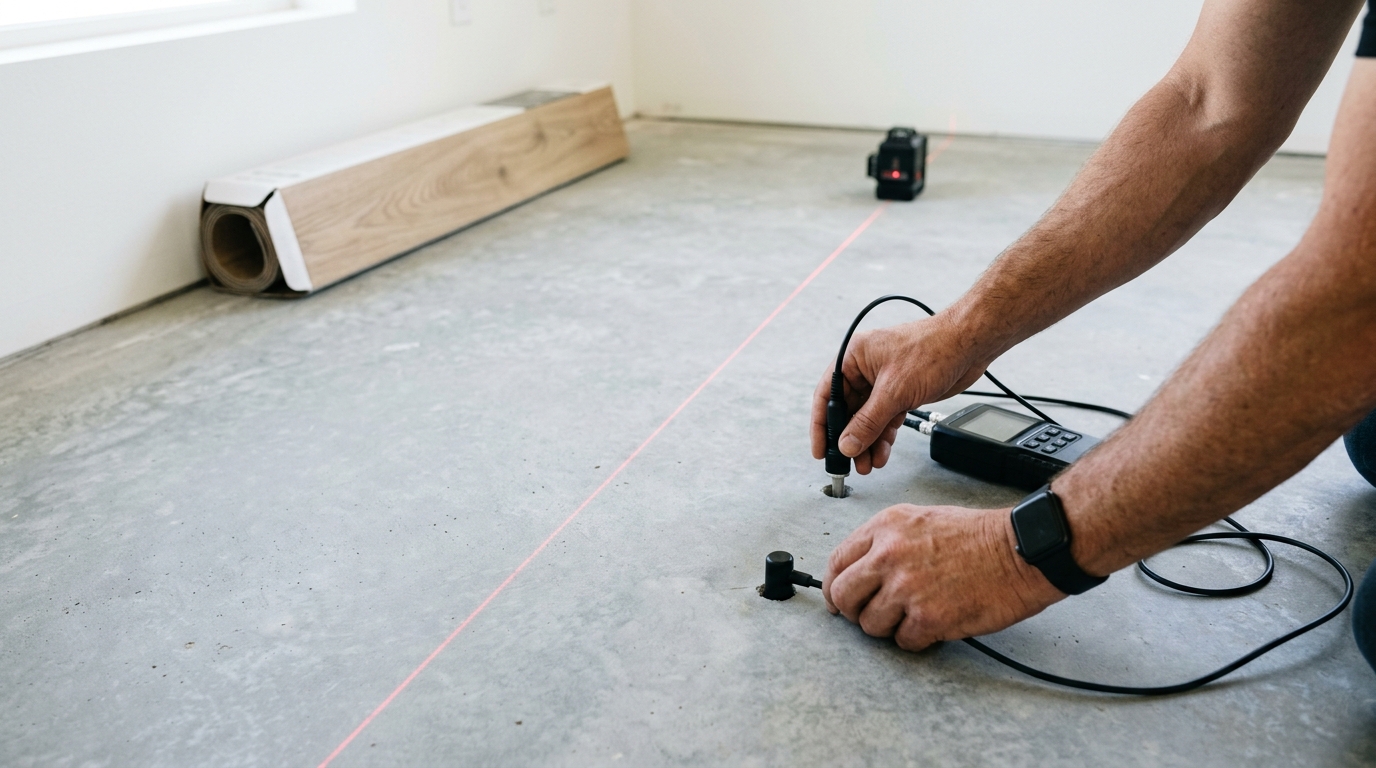
Before any installation, ask for a moisture test on the slab. Calcium chloride and in-situ relative humidity probes are the two accepted methods. If readings are high, a vapor barrier or epoxy moisture mitigation coat adds $2–$4 per square foot but prevents a failed floor.
Heat matters too. Sun-exposed rooms near sliding glass doors can push floor surfaces past 100°F. Some LVP products warp or expand in these conditions, so choose rigid-core (SPC) planks rated for temperature swings and install with the recommended expansion gap, usually 1/4 to 3/8 inch.
Porcelain is the standard for tile installation in Miami. It absorbs less than 0.5% water, resists mildew, and stays cool underfoot. Ceramic costs less but chips more easily and suits walls and low-traffic areas better.
Labor is the largest variable. Demand a written scope that names the mortar type, grout type, layout pattern, and who handles demolition. A quality installer can lay 80–120 square feet per day on standard layouts.
Terrazzo is common in mid-century Miami homes and condo buildings. Original floors are often in better condition than they look. Restoration costs $4–$12 per square foot, far below the $15–$40 for new terrazzo, and the process preserves a floor that can last a century.
A standard terrazzo restoration includes these steps:
Replace rather than restore only when cracking follows slab movement, when the floor is delaminating from the substrate, or when water intrusion has damaged the base. Cracks from slab movement return unless an isolation membrane is installed beneath the new surface.
LVP suits apartments, rental units, and remodels where speed and budget matter. A floating SPC installation on a flat slab finishes in one to two days for a typical bedroom suite, and the product is waterproof at the plank level.
Look for a wear layer of at least 12 mil for residential use and 20 mil for rentals or high-traffic units. Avoid thin, flexible vinyl over uneven concrete, since every imperfection telegraphs through. LVP does not add the resale value of tile or terrazzo in higher-end Miami markets, but it performs well for property managers who turn units frequently.
Most flooring failures in Miami trace to moisture and poor prep, not the material. Loose tiles usually point to missing mortar coverage; the standard is 80% coverage in dry areas and 95% in wet areas. Hollow-sounding tile can often be removed and reset individually rather than replacing the whole floor.
Maintenance is simple. Use pH-neutral cleaners on tile and terrazzo, since acidic products etch terrazzo and marble. Reseal terrazzo every 1–3 years depending on traffic. Wipe up standing water around LVP seams, and keep AC systems serviced, because a clogged condensate line is a common source of floor water damage. Our team handles handyman services for tile repair, trim, and transitions, and a Miami electrician can coordinate with floor work when outlets and fixtures need adjusting.
Insist on a written One Year Warranty covering workmanship. For urgent issues such as lifted tile, water damage, or trip hazards in a rental, Same Day Repair availability limits liability and tenant disruption.
Porcelain tile is the best overall choice for Florida homes because it resists moisture, mildew, and heat and lasts 50 years or more. Waterproof SPC vinyl plank is the best budget option.
Tile installation in Miami costs $8–$20 per square foot installed in 2026, including materials, mortar, grout, and labor. Large-format tile, diagonal layouts, and demolition raise the total.
Yes. Terrazzo restoration costs $4–$12 per square foot compared with $15–$40 for new terrazzo, and a restored floor can last decades. Replacement is only necessary for structural cracking or delamination.
Engineered hardwood works on upper floors or over a vapor barrier. Solid hardwood is not recommended on concrete slabs because humidity causes cupping and gaps.
LVP takes one to two days for a few rooms. Tile takes three to seven days including curing and grouting. Terrazzo restoration takes two to five days depending on size and damage.
Call us today or fill out the form and we'll call you back within 2 business hours. Plans start at $69.99/mo.
1-833-426-3942